Friday, July 25, 2014

Hire a bike in Berlin and drop it off in Copenhagen

If you hire a car in Madrid and wish to drive to Oslo, you can leave it in Oslo at a branch of the company. It will cost you a few pounds/dollars/euro/krone more, but you can do it. Normally it is not possible to rent a bike in one place and return it somewhere else. We have written about this problem recently.

We are planning a tour along part of the Berlin-Copenhagen cycle route and by chance I discovered that you can rent a bicycle in Copenhagen and return it in Berlin or vice versa. 
Fahrradstation (a Berlin bike hire company) in collaboration with MTB-Tour (Værløse, Copenhagen) offers the opportunity to rent a reliable bicycle in Berlin to ride this beautiful and famous international cycle route and then easily return it in Copenhagen. As well as the other way round!  You can enjoy a one-way ride without worrying about returning the bike to the starting point.

Choose your two-wheeler among a range of:
  • trekking bikes
  • mountain bikes
  • e-bikes
but also childrens' bikes and tandems!
Bike7 Days10 Days14 Days
MTB€ 199,-€ 229,-€ 259,-
Trekking Bike€ 199,-€ 229,-€ 259,-
E-Bike€ 299,-€ 349,-399,-
Child's Bike
€ 169,-
Tandem

€ 399,-
For any further information and for reservation, contact Fahrradstation  at berlincopenhagen@fahrradstation.de.

Friday, July 18, 2014

Refreshing non alcoholic drinks for touring cyclists.

If you are lucky enough to come to Germany this summer, you will be faced with a wide range of beers to try. However at lunchtime bear in mind that a typical German beer has an alcohol content of between 4.5 and 5.5%. Half a litre of beer can fill your legs with lead when you set off.  You find that the hills are steeper than they were before lunch and the fields you pass get every more inviting. Alcohol is an excellent diuretic and you might find yourself nipping off into the bushes too often. It's probably better to lay off the booze at lunchtime. So what do you drink? If like us you are not a cola fan and you want a cold drink, you can order a water, but be prepared it'll be a mineral water and not free. The economics of a German restaurant are such that the customer receives expensive mineral water and not free tap water. Sorry, that's how it is. Try ordering a nicht-alkoholisches Weizenbier. This is a cloudy, very low alcohol wheat beer (less than 0.5%) and it tastes much like a yeasty normal Weizenbier. Try it. A lot of cyclists drink it not only at lunchtime.

Thursday, July 17, 2014

Bike Hire in the Rhine Valley between Ludwigshafen and the border with France on the left bank and between Mannheim and the Black Forest on the right bank.


We have been asked a number of times about hiring a bike at the start of a trip and dropping it off at the end. Although this idea is common enough in the motor car hire industry, it appears to be a concept that is too difficult manage in the bicycle hire industry. Basically if you want to hire a bike choose a circular route like round Lake Constance. Otherwise you will need to return the bikes to your starting point. Having said this there are exceptions:

  • Luxembourg, but as the country is only a little bigger than a postage stamp, this is not much of an advantage.
  • Rheinhessen between  Mainz and  Worms.
  • The Niederrhein Region between Düsseldorf and the Dutch border.
  • Switzerland, if you hire a bike for  two days or longer.
  • You can hire a bike in Berlin or Copenhagen and drop it off in the other city.
All of the above areas will let you hire a bike in one town and return it to a hirer in another town, but in comparison to hiring a car in Copenhagen and dropping it off in Madrid it's small beer. 

We have found another local company, bellorange® ( www.bellorange.com) that hires bikes in 15 small towns and villages between Ludwigshafen - Mannheim, the French border by Wissembourg and into the northern Black Forest. They offer a wide range of bikes, e-bikes and tandems. The website is only in German, but it features an interactive map which makes it very easy to use. This is odd because the company has a brochure in German, English, French and Spanish.

Friday, July 11, 2014

All over Rain Suit for Cyclists: Bikesuit

We have been using Rainlegs over-breeches for some years and found then to be a good way of keeping off the worst of the damp when it rains (http://www.rainlegs.com). Rainlegs cover the upper portion of the thighs and leave the rest of the leg free. This means that you are not bathed in sweat after a few kilometres in the rain - the problem with over-trousers. They are especially useful in showery weather when they don't need to be taken off once it stops raining.
We have just ordered a replacement set of Rainlegs and I noticed on the website that the company is about to sell an all-over garment resembling a multi-zipped boiler suit with a hood and feet cover in a waterproof, breathable fabric called the Bikesuit. This will be introduced to the world at the Eurobike Exhibition in Friedrichshafen, Germany in August. This is all we know. How much it weighs? How much will it cost? We do not know. There is a video of the garment in use on http://bit.ly/bikesuitpress.
The one thing we are not taken with are the partial feet covers as these tend to get holed when the rider puts his feet on the ground. It would be better if you could use the garment for walking in the rain.

Monday, July 07, 2014

Value for Money Cycle Tourists' Hotel in Passau on the Danube Cycle Route

By chance we found and stopped in the Rotel Inn in Passau recently. It's on the Danube Cycle Route. We can recommend it. The beds are 2.50m wide as are the rooms. The rooms are not ensuite but the facilities are across the corridor.  Fifty Euros for a double room or 30 Euros for a single plus six Euros each for breakfast. The hotel is clean, comfortable and the breakfast is value for money. It is five minutes from the Hauptbahnhof (main railway station). There is WLAN/WIFI if you ask for it at the desk.

Friday, July 04, 2014

Cycle touring. Booking accommodation in advance.


We decided on a recent week long tour following the Inn Valley Route to book all our accommodation in advance. Some of our nights were spent in youth hostels. In our experience it is very difficult to find a double room with or without shower in a youth hostel just by turning up at the door.

We also used booking.com to book accommodation on several nights. This site avoids problems with landlords who would normally bar touring cyclists because they only wish to stop for one night. Single night book bookings are accepted. I presume the other websites offering booking are similar.

The great advantage is that the room is booked and guaranteed. There is no need to flog yourself into a heart attack to get to the hotel by 18:00, say, in case the owner decides you are not coming.

There are a few problems however with these systems:
  • These websites do not always have all the accommodation in a city, town or village on their books. This means if you don't find a hotel on one site it pays to check one of the other booking sites.
  • Check exactly where the hotel or guest house is. We just booked ourselves into a hotel about 200m (about 650') above and 3km away from the cycle route. It was a long walk pushing a heavily laden touring bike.
  • Another snag is that these organisations fill your email in box with offers afterwards.
  • In our experience there do not appear to be many B&Bs on these websites' lists. There are however special websites offering B&Bs. Feed B&B and the name of the country or the area you are interested in into your favourite search engine.
  • Make sure you know how to get to the accommodation. Use one of the map apps to download the exact position. 


Sunday, June 29, 2014

Aldi's cycling gear: The vest

They are superb and keep one warm once the temperature falls.

"Cycling the River Rhine from Basel to the North Sea"

The book is finally there,  on Smashwords.com or on your local Amazon site. The book costs US$8.99.

Friday, June 27, 2014

Train travel with bike in Germany

Long distance train travel with a bicycle in Germany normally means changing trains more often than you would do without a bike.  It can be stressful and hard work. Few long distance trains in Germany take bicycles because the "Fat Controllers" of Deutsche Bahn (DB) are worried about the time it takes for cyclists to remove their steeds from ICE - high speed trains and the space bicycles take up. Bicycles are not allowed on these fast trains, which make up the majority of long distance trains in Germany. Some slower long distance trains do take bicycles, as do regional trains. The latter are specified and subsidised by provincial governments who are interested in encouraging cycle touring, so most German regional trains take bikes. When you book your ticket with DB the route seems to be  planned so you travel the maximum distance on DB long distance trains. What this means is that unless you are lucky, a cross country journey will not be the most direct route, but involve hopping from regional to long distance trains and back again. Fortunately DB issues you with a detailed plan of where to change and from what platform. (http://www.bahn.de/i/view/DEU/en/index.shtml) However this list omits to tell you how to get from one platform to the next, usually within five to ten minutes. Obviously if you just have cross from one side of an island platform to the other, it is easy. OK you might have to run from one end of your train to the other end of your connecting train, but see this as a little morning exercise, provided free of charge. If you have to change, say, from platform 1 to platform 3 you will need to cross the lines, i.e. descend to an underpass or climb a bridge. In larger stations there are lifts/elevators, but these can be very narrow and cause long queues of impatient cyclists, pram pushers, wheelchair users. In smaller stations or if the queue is too long the only option to descend to the underpass is via a flight of steps. This can be difficult, if the train was full of other passengers hurrying to catch their connection and the cyclist is not a well trained weight lifter. A laden touring bike is difficult to carry down and up a flight of steps. There is a cure to the problem and German station designers only have to travel to Switzerland to experience this. Swiss railway stations have ramps to the platforms. They are simple and effective and they don't break down. Why few ramps in Germany? Too low tech or maybe they might take up space that could be used for yet another cafe, hamburger joint and  shop selling pots and pans. The next problem comes when the train arrives. You have two minutes to get yourself, bike and baggage on the train. Sometimes other cyclists are descending. Sometimes you need to carry the bike up a flight of steps resembling the Eiger North Wall. It pays to take your panniers off the bike and if you are not on your own, work as a team. Once you get on board, you need to find your bike slot where you might have to hang your bike from a hook or slot the front wheel over a lower hook. Fat MTB tyres can be a problem in both cases.


Although there are some stressful aspects to travel with trains, on the other hand you meet other cyclists who are very helpful in our experience. It is an all hands to the pump situation.  In our experience German Railway employees are also  helpful as well.

Monday, June 23, 2014

Do you need a waterproof, windproof cycling coat for the winter that you can wear to the office or theatre - Mooi Cycling Coats

We went to the Radsalon - a bicycling event in Mannheim on Saturday - to work on the ADFC stand, As we left I did a quick survey of the other stands and discovered Mooi coats which are made of synthetic fibres which resemble wool (http://mooi-diemaentel.de/en/index.html). The coats are stylish, for both men and women.  The designer has set up a crowd funding site on www.startnext.de/mooie-die.maentel and you can subscribe to buy a coat for what seems to me to a reasonable 195 Euros. People from outside of Germany will need to pay a little more for postage. Contact the designer via the website.

Monday, June 16, 2014

Booking a self-guided cycling tour on the continent (Europe) with a local company

Several British companies offer self-guided cycle trips, but it is worth thinking about booking with a  European based company as some British companies use these foreign companies to organise their trips. Why pay two sets of agency fees? The disadvantage in booking a trip with these organisations is that you do not get ABTA protection if the company goes down the pan. However Eurobike, an Austrian company (http://www.eurobike.at/en) has been around for some time. The company has an interesting website and offers a wide range of holidays.

Friday, June 13, 2014

Winterize your bike


Seen in Heppenheim last weekend but one. Thanks to musician friend Reinhard for taking the photos. Check out his website on http://www.maibauer-gleisner.de/reinhard/

Monday, June 09, 2014

Tour de Karl 2014

The city of Mannheim organises an annual cycle ride for school classes to commemorate the first trip on a bicycle by Karl von Drais on his hobby horse invention from the centre of Mannheim to a pub on the then outskirts of Mannheim in Neckarau in 1817. The aim is to encourage cycling to school and remind children of von Drais's ride. This year it was held on the European Day of the Bicycle: 3 June rather than on the anniversary of Herr von Drais's trip, because this falls on a public holiday this year. Four hundred school children accompanied by a police motorcycle escort, some of their teachers, volunteers from the ADFC, the German Cycling Club and a sag wagon - a bus from the local bus company cycled about 7km from the centre of Mannheim down to a school in Neckarau. Judith and I were amongst the volunteers. We pumped up tyres and adjusted brakes before and after the event. A good time was had by most. Only four children needed the services of the sag wagon.

Friday, June 06, 2014

Low life in Dordrecht

On our recent research trip for the new edition of Rhine 2 from Emmerich to Hoek van Holland we had noticed that our maps were out of date and so I nipped into the VVV information centre in Dordrecht to buy more up-to-date maps to check the routes when we finally finish the book. While I was away Judith chatted up a bicycle policeman and asked him about bike theft. He replied that Dutch roadsters were a favourite of Dutch thieves. "Odd or special" bikes like our Bromptons were not of interest to the bike thieves. They were too difficult to get rid of. The reverse is true in London.  Bromptons are standard bikes there and seem to be very high on thieves' hit lists.
Judith experiences the long arm of the law.

Monday, June 02, 2014

Deliveries by bike in city centres.

Two light delivery vehicles block a street in Orléans, France.
Older city centres and many residential areas were not designed with modern traffic or goods deliveries in mind. Traffic delays are inevitable. These delays increase carbon dioxide output and reduce air quality because motors run for longer. This is as true for Germany as for anywhere else. The Bundesministerium für Umwelt, Naturschutz und Reaktorsicherheit (BMU - German Federal Environmental, Nature Protection and Nuclear Safety Ministry) has set up a programme to assess reducing the use of motor vehicles by courier companies in major city centres in the hope of reducing congestion, and hence lowering the emission of greenhouse gases and air pollutants. It is thought that up to 85% of local small deliveries at present made by small vans could be made by a pedelec cargo bikes. This “Ich ersetze ein Auto” - (I am replacing a van) programme is part of the National Climate Initiative where environmental and economic interests go hand in hand. The project supports use and development of new technologies in companies based in Germany, to increase competitiveness and create and secure jobs. The German government has clear aims when assisting industry.
The Austrians have stolen a march on the Germans: Grocery deliveries in downtown Vienna, Austria.

The aim is to answer the following questions during the two-year project:

How effective is the replacement of light delivery vehicles by pedelec cargo bikes in reducing carbon dioxide emissions and environmentally damaging traffic in major cities?
Which urban courier services offer the greatest potential for this transport?
What percentage of light van courier services could be carried out by couriers on pedelec cargo bikes?
What opportunities will arise from the use of pedelec cargo bikes for urban courier services and their clients?
What are the factors influencing the switch to an pedelec cargo bike by self-employed couriers and messenger bike riders?

The project 

The project is a very typical German government supported research programme involving government money, a project involving customers and manufacturers and a research organisation to manage the whole thing.
The environmental ministry, i.e. the German taxpayer is coughing up the cash.
The customers are courier services. Independent and employed couriers and bike messengers in Berlin, Hamburg, Munich, Dusseldorf, Leipzig, Nuremberg and Bremen have agreed to use the pedelec cargo bikes in their daily work. Both car and bike couriers are interested in the project: The electrically powered project vehicles and major potential savings for car couriers make switching to an electric cargo bike an interesting alternative. The pedelecs are cheaper to buy, to operate and offer major savings on parking tickets. For the bike messengers, the electric motor provides direct competition in the market for car courier jobs. This means: Heavier goods can be transported over long distances, which generates more revenue for couriers with pedelec cargo bikes.
DLR, the German national aeronautics and space research centre is responsible for project management and assessment. During the evaluation of the electric cargo bikes’ potential, order records and the routes followed are analysed. In addition, couriers, technicians, dispatchers and customers are being interviewed to gain information about the general acceptance. All the vehicles have the same appearance, including the logo "Ich ersetze ein Auto" (“I am replacing a van”) to raise the interest of further potential customers and users.

Friday, May 30, 2014

Aldi to sell special offer cycling gear just before le Tour hits Yorkshire

According to the editor of "Cycle" the CTC bimonthly magazine, Aldi UK is having a sale of cycling gear on 29 June. British cyclists should get ready to to get queueing.

Monday, May 26, 2014

Bicycle Rental in Luxembourg City

Vélo en Ville Asbl
8 Bisserweg 1238 Luxembourg
T: +352 47 96 23 83
Bicycles, mopeds, motorbikes and trikes rental service
(Whether the trikes are HPV or converted motor bikes is not clear.)

Saturday, May 24, 2014

Cycling in the Netherlands

If you would like to read a description of one of our typical research trips to prepare a new cycle guide, then check out  http://www.crazyguyonabike.com/doc/Rainydays.

Friday, May 23, 2014

Bicycle Hire in Dordrecht, Netherlands

The bike shop at the bike parking facility at the NS railway station in Dordrecht hires bikes. Single gear bikes cost 7.50 Euros a day. Three gear bikes 9.50 Euros a day. E-bikes cost 20 Euros a day. More details on the website. The hire information is in English.
Bike Totaal Zwaan, Stationsplein 6,  T: 078 635 6830,  www.czwaan.nl

Maia Ligfietspunt
Stevensweg 79a
3319 AJ Dordrecht
T: 078 - 616 63 02,  06 – 209 28 962
E: info@maialigfiets.nl
This company offers a wide range of recumbents, recumbent trikes, tandems, bakfiets cargo bikes and even conventional bikes for hire. The website http://maialigfiets.nl is in Dutch. Look for "verhuur".

The VVV Zuid-Holland Zuid Tourist Information has e-bikes for hire. Spuiboulevard 99, T: 078-632 2422,  www.vvvzhz.nl

Monday, May 19, 2014

Carrying rucksacks, panniers and cardboard boxes on bicycles

I am amused/horrified by cyclists who need to carry heavy loads. A favourite is on their backs, rather than letting the bicycle frame carry the load. Another approach is to pop a rucksack or briefcase in a basket on the rear of the bike (better!) but then hold it down with one hand.
Some riders have to wear their load as they use road bikes to tour and commute. Road bikes are useless for anything except as a way of going fast and getting fit. They do not normally come with lugs to attach a carrier.  Others do not have any convenient way of attaching a bag to the bike rack. The standard way to attach a bag is to buy a couple of cheap and cheerful bungees.  These give me the willies. When I stretch them I have a vision  of a skewered eyeball when the hook slips. I have just come across a set of straps with a safer design: ROK Commuter Straps (http://www.rokstraps.com). You loop the strap onto the bike rack, click the buckles together and  tighten the strap around the bag.
As soon as we can find a dealer they will be bought.

Friday, May 16, 2014

Roadside emergency services for cyclists

We found an article in the Denver Post (Denver, Colorado, USA) recently: 

"Cyclists, rejoice: AAA Colorado has expanded its roadside assistance program to cover bicycles, which means members whose bikes break down during a ride can now call for help.
Under the expanded program, AAA will retrieve members and transport them and their bikes to the destination of their choice for no extra charge , AAA Colorado spokeswoman Wave Dreher said. "*

I think it is a capital wheeze, but whether it is applicable to Europe I don't know. Whether the AA, the RAC, the ADAC, ACE, etc. have the extra capacity to supply more services is debatable, although some of them do charge serious sums of money for their services, for their insurance. 
The Dutch motor club, ANWB does offers a bike roadside assistance insurance scheme (translated from Dutch): 
Bicycle Breakdown 
Roadside Bicycle Service is roadside assistance for your (electric) bike, road bike or cargobike. 
24/7 roadside assistance in the Netherlands. 
If the bike cannot be repaired on the spot. The ANWB will bring you to your destination or to a bicycle shop. 
The service costs 24 Euros annually. There are discounts. There is more information on the ANWB website: http://www.anwb.nl/wegenwacht/fiets in Dutch only, but it translates well with Google Translator.
If your bike  breaks down, there is also a chance that a passing cyclist will offer to help you. It does happen, but not always as our experience in Mainz shows (http://www.crazyguyonabike.com/doc/13861).

Read The Denver Post's Terms of Use of its content: http://www.denverpost.com/termsofuse
Follow us: @Denverpost on Twitter | Denverpost on Facebook

Monday, May 12, 2014

It makes my heart beat faster.

Das Museum der Arbeit (The Museum of Work) in Hamburg has an exhibition "THE BICYCLE, Culture, technology, mobility " until 1 March 2015. The 600 sqm exhibition has over a hundred iconic historic bicycles of the past 200 years. It details the technological development, the design, the diverse bicycle scene, and mobility aspects of present and future - from the "hobby horse" to the Hamburg "StadtRAD" and the penny farthing of dandies to today's cargo bike bicycle couriers. We will try to spend an afternoon there on our way to Denmark later in the summer.

Saturday, May 10, 2014

Bicycles in ICEs?

The "Mannheimer Morgen" reported today that the next generation of ICEs will have provision for full sized bicycles. It might be a week or two though, before you can pop your bike on an ICE in Hamburg to go to Basel. The first eight train sets are due to be delivered in 2017.

Friday, May 09, 2014

World Klapprad Races in Berlin

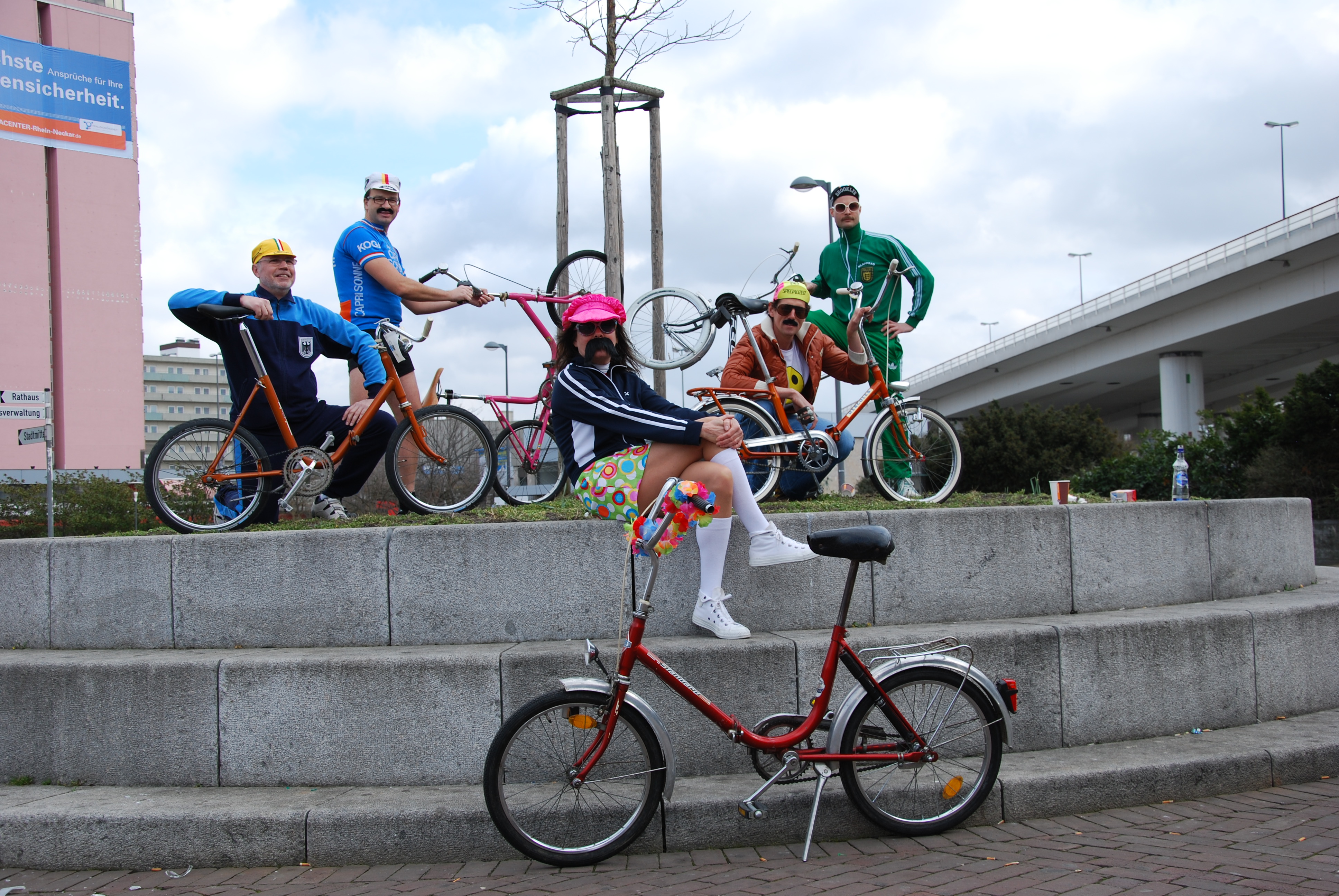
The Giro starts today in Northern Ireland and the Tour de France starts on 5 July in Yorkshire, but both events pale beside the one on 17 May (next week) when the World Klapp Race Series takes place away from its Ludwigshafen home in Berlin for the first time.  The Merkel Loop, the 1.8km long circular course along the Straße der 17. Juni past the Brandenburg Gate, the Reichstag and Platz der Republik offers excellent viewing for the expected 20 000 visitors, including Chancellor Merkel from her office window. Brits should imagine a bike race from the Houses of Parliament, up Whitehall around Trafalgar Square and along the Mall to Buckingham Palace and return. In total 32 teams of four riders all of whom must wear moustaches*, will complete three circuits of the course riding Klapprads with carefully defined characteristics:
  • The Klapprad must be at least 30 years old. Folding bikes like Birdies or Bromptons are not allowed.
  • The Klapprad shall not possess gears or a duomatic gear. A suitable gear for Berlin can be mounted.
  • Racing or time trial handlebars are absolutely excluded - use the original handlebars, or similar.
  • Klapprad tandems are not allowed
  • The use of click pedals is recommended
  • Ideally, the Klapprad has mudguards, foxtail and a functioning lighting system
The time of the third fastest member of the team will determine the winners.  The winners will receive the Berlin Bear Trophy, with its cool shades and, of course, a moustache.

*In spite of this, ten of those taking part are female. 

Vennbahn: Cyclist-friendly accommodation in East Belgium

If you wish to cycle along the Vennbahn from Aachen, Germany to Trois Vierges, Luxembourg, then it will be good news that Tourist Authority of East Belgium in cooperation with the LVI, the Luxembourg Cycling Club and Velosophie tourism consultants in Luxembourg has organised a Bed and Bike guide similar to the German ADFC Bett und Bike Guide and the Luxembourg LVI Bed and Bike Guide. The guide will lead cyclists to cyclist-friendly accommodation along the 850km of cycle routes in German speaking Belgium. The easiest way of accessing the guide for non-German speakers is to log onto the English version of the German www.bettundbike.de by clicking on the Union Flag upper right. Belgium can be found under Countries. We have yet to find anything similar for the UK, pity really.

Sunday, May 04, 2014

Cycling in Europe Guide updated

We have rewritten the "Cycling in Europe" collection of helpful hints and suggestions for touring cyclists. It is available from Amazon (search "Cycling" "Forsyth" in the Kindle Shop) and from Smashwords (http://www.smashwords.com/books/view/245564) now. There is a lot more information about where to cycle in Europe: The latest information on the instant fines levied by German policemen; downloading GPS tracks; a photograph of the best guarded bike rack in the world; putting bikes on trains and busses in Europe and how to save money by not buying mineral water.

Saturday, May 03, 2014

SPEZi Special Bicycle Show Germersheim 2014


HG Wells is quoted as saying: "Every time I see an adult on a bicycle, I no longer despair for the future of the human race." If he'd have been in Germersheim at SPEZI, the Special Bicycle Show, over the last weekend in April he would have been giggling with joy. Perhaps I have the wrong idea but I have the impression that the big bicycle shows like Eurobike, Taipei International  or Interbike are where the suits meet to talk business to create "comprehensive trade platforms" or "manufacturers, retailers, media & more conduct the business of cycling". SPEZI is where the real freaks come.  I read a comment by a representative of HP that SPEZI is "back to the roots". It is where the companies get to meet people who are prepared to dig deep and want decent answers. People with disabled family members who still want to cycle together or who want them to learn to cycle. People whose vision of towns and cities is without motor cars and diesel powered delivery trucks.  It is where the garage-based inventors come to show off new ideas or rejuvenate old ones.  Fans check out bicycles or tricycles that cost more than newish secondhand family saloons. In a word, it is wonderful. 
The two day exhibition covers three halls, an outdoor area and three test tracks (children's bikes and trikes, adult bikes and trikes, electrobikes and trikes). These are our impressions of the show. We did not see everything. We could only visit the show on one day this year.

Accessories

Recently we wrote about assembling a pair of gloves that could be used as direction indicators at night. If knitting a pair of gloves and assembling the electronic bits and pieces is too much work, then check out GTC Germany Ltd who offer gloves with a built in lighting feature. (http://www.blinkerhandschuh.com/) OK, it's a gimmick, but it could well be a gimmick that saves your life on a dark night in city traffic. Anything that makes you more conspicuous is a good thing.
Two other possible life savers are a Hubbub helmet mirror sold by Junik (www.junik-hpv.de)
and a mirror to fit a glasses arm sold by Pedalkraft (http://www.pedalkraft.de/spiegel.htm).

Cargo Bikes
In addition to the trike pickup models, long john etc. , we noticed a well designed trailer from Hinterher.com. This was so popular with visitors that we could not take a photograph as we couldn't get near enough.
The outdoor exhibition area had a number of cargo bikes on show:
Bernds has a steel frame 20” wheel Trike Pick-up. It has a load capacity of up to 140kg, and with its Pick-up holdall, it will handle a weekly shop. A low frame design, suspension rear, and balloon tyres make it an ideal vehicle for anyone  including people with physical limitations.
Maderna.MCS Trucks (www.maderna.at)
Radkutsche Rapid cargo bike as a transporter for children
A Radkutsche Muskatiere as a mobile home (http://www.radkutsche.de)
  • Race This replaced the Saturday afternoon trike race that stopped two years ago. Participants had to move a number of car tyres and empty beer barrels across a short course.  It sounds like it is good fun and we will try to be there next year on Saturday afternoon to watch it.


Integrating people with disabilities

It is heartening to see the efforts to integrate disabled people into the cycling world with the Hase Pino as a good example. There are a growing number of companies offering human powered and electrically assisted bikes, trikes and vehicles for the ever growing number of older people who want exercise but not take part in the Tour de France.   

Enthusiasts

Although over the years SPEZI has lost some of its home made bike builders, there are still thankfully courageous pioneers who want to offer a different approach to cycling. We had a long talk to Christoph Lenz on the Maynooth Bike stand (http://maynoothbike.com). He has designed and constructed a semi-recumbent bicycle where rather than turning the drive wheel the rider pumps the pedals up and down. It looks like a lot of fun and should make an effective comfortable, city and shopping bike. It would also be helpful for amongst others people who have not cycled for some years, as one can put one's feet down quickly. The problem we see is that not only are engineers and cyclists very conservative, but also the conventional bicycle has over one hundred years development behind it. It will take a lot of effort on Christoph's part to persuade the cycling community to change its ways. We wish him well in his efforts. 
The Maynooth Bike


A foot braked Maynooth Bike for a customer who has difficulty using their hands. 

Mosquito
A velomobile built out of wood, carbon fibre and a plastic or fabric skin to very strict design rules by two Frenchmen in London and Valence (http://mosquito-velomobiles.com/index.htm).
Veloschmitt
A electro velomobile design based on the post second world war Messerschmitt Kabinroller (www.veloschmitt.de). These are on sale for about five or six thousand Euro.


Fitness

There seemed to be more interest in fitness bikes this year:
Elliptigo showed its stand up bicycles which use a cross country skiing motion to propel the bike at a rate of knots. It is probably very invigorating.
Both the Ruder-Rad and Varibike let the cyclist use their hands in addition to their legs to power the bike. This gives you a whole body workout. You need to move the Rudi-Rad handlebars backward and forward in a rowing action. (www.ruder-rad.de) The company builds recumbents, city bikes and tandems with and without electrical assistance.
A rowing and pedalling recumbent from Ruder-Rad
On the Varibike cyclists pedal with both hands and feet. How difficult both bikes are to steer when using the hands to propel the bike is not easy to say. I suppose you can stop using your arms to propel the bike and just use your feet if you need to concentrate on steering.

Mainstream

On the ICE stand we saw the trike that Maria Leijerstam cycled from the edge of the Antarctic to the South Pole in 2013.
An amazing effort


mmmm!
We were interested to hear on the HP stand that one of their trikes is now offered with 8cm higher seats, as OAPs like ourselves have difficulties getting up from near the ground. We noticed too that most manufacturers now offer an upright pole as an accessory to aid owners of rheumaticky limbs in getting up.  This has been a feature on Anthrotech trikes for many years.
 Anthrotech trike seats are high above the ground anyway. 
There is a definite trend towards building folding bikes and trikes. This is not so much to make the bike or trike small enough to carry on a train when commuting, but more to load it in to a car or store it easily at home. Both HP and AZUB had folding trikes on offer. Gobiidae Trikes from Barcelona, a new company for us has three models, one of which is a folding model (http://www.gobiidaetrikes.com/).
PedalPower one of the growing number of bike fabricators in Berlin had a folding tandem on its stand.
PedlPower folding tandem.

Miscellaneous

In the outdoor area one could try a Quattrocycle, a Dutch built four wheeled four passenger human powered and/or electrically assisted rig that would be ideal to bowl along a promenade on a sunny day. (http://www.quattrocycle.com/uitvoeringen/quattrocycle/index.php).  Although all four passengers can pedal in whatever gear they wish or not pedal at all, only one steers and brakes. It appears to be a somewhat complex matter, though from the serious discussions between family and hire company taking place:


Osborne's Delight

The British government is trying to encourage manufacturing rather than high finance and so we were pleased to see Union Flags on Airnimal, Bromptons,  Circe TandemsICE trikes, KMX trikes and (virtually) AVD's Windcheetah trikes. We would be even more pleased if Her Majesty's Government would invest more than fine words to cut down cyclists' accident rates,  in cycle paths, e.g. and worked out a way of encouraging more folk to invest in industry rather than bricks and mortar. It is apparent from the experience of both Berlin and Copenhagen that investment in cycle ways spurs development of a bicycle building industry.
We were somewhat surprised on the AVD stand to be accused of being from Yorkshire as we are both Lancastrians, but the next time we are in Bolton we will try to nip up to Darwin to observe production there.  
We are always pleased to visit SPEZI, because Voss, the German Brompton importer, sells spare parts that are difficult to find elsewhere without paying p&p for mail order. Both our Bromptons are pushing 20 years old and it is not surprising that the elastic cords on the baggage rack for example, have given up the ghost.

Test Areas
  • Children
  • Adults
  • e-Bikes I am afraid our tea addiction drove us home at this point.
Practical
    • Travel 
      • There are airports in Frankfurt, Hahn, Strasbourg, Baden and Stuttgart, if you must fly.
      • Good high speed train connections from London to Strasbourg via Paris and Mannheim via  Paris or Brussels. 
      • Good regional train services from Karlsruhe and Mannheim. Connections from Strasbourg via Lauterbourg and Wörth.
      • There is plenty of free car parking space available, but you might have to walk for ten minutes.
    • Tickets
      • Tickets can be ordered in advance about two to three weeks beforehand with payment using SEPA and picked up on the door. Getting in is less of a problem than it used to be. Then are now four ticket sales points at the main entrance, one at the back of Hall 2 and one in Hall 3.
    • Accommodation.
      • Lots available locally. Talk to the town's tourist office.
    • Catering
      • Excellent. If you don't fancy the three course menu for €12.50 in the restaurant, there's a cheaper self service area downstairs or you can walk into town to eat in a pub there.
PS The next SPEZI will be held on 25-26 April 2015.  

Germersheim

Germersheim is a town set in the remains of  19C fortifications. It is an interesting little place. It is set in Rhineland Palatinate whose southern portion was part of Bavaria from 1814 to 1946. Germersheim's Bavarian rulers started to build a fortress in 1831. It was completed in 1855, although excavations for underground passages continued until 1861. By this time, however, the fortress was outdated, as artillery had improved greatly in the thirty years since work began. The fortress was destroyed in 1921/22 under the Treaty of Versailles. Some parts still exist. As you approach SPEZI you pass a number of 19C buildings that were part of the fort. The town is home to the University of Mainz Institute of Translation.
Fine parks
A memorial to to some of the Bavarian units that were stationed in Germersheim.


Friday, May 02, 2014

Cycle route planning in Germany with GPS download

Germany is a federal republic and cycle routes are the responsibility of the provinces, so formerly you had to check a number of sites if you wished to plan a cross country route. However those provinces that have online official route planners have got together under the VeRa website: http://www.radroutenplaner-deutschland.de/. Although it is in German it is easy to use. When you open the website there is a map showing the various provinces. Those that are brightly coloured offer route planners that cover the province and a few kilometres over their borders. Click on the map to use its cycling information systems. These programs also offer the possibility of planning routes into other provinces. Using the Baden Württemberg planner, for example, you can work out a route from Basel, Switzerland to Cologne through four different provinces.  
At the time of writing the following provinces offer route planning with GPS download: 
  • Baden-Württemberg: German only, iPad Android App available.
  • Bavaria: German only.
  • Hesse: English available iPad Android App available.
  • North Rhine Westphalia: English available.
  • Rhineland Palatinate: English available.
  • Schleswig-Holstein: English available.
  • Thuringia: English available.


Bremen can be accessed via VeRa. The website is in German only with no GPS. It is a very small area.
Berlin also has a route planning program available, but not via VeRa: The http://www.bbbike.de website offers a German language route planner with the option of Android and iPhone apps

Saturday, April 26, 2014

Copenhagenize your cycle touring instantly

There is an excellent website about cycle way design based on experience in Copenhagen called http://www.copenhagenize.com. It is almost heavenly to cycle in Copenhagen, but it has taken 40 years of hard graft to get to the point where over a third of all journeys in the Copenhagen metropolitan area are made by bike.
We and well over a hundred others managed to achieve this nirvana this morning. The German Cardiologists Society met in Mannheim this week and today there was a cycle ride as part of a campaign to popularise exercise as a way of keeping heart problems at bay. Our cycle club, the ADFC supplied experienced cyclists to ride with the group. We were amongst these and left the Mannheim Congress Centre with about 100 others. When I heard the route described which included riding along Mannheim's ring to the then dive under the railway lines to reach the Rhine, I was not happy. However we had four police motorcyclists with us and they blocked off traffic on any road joining that could have given us problems. This is a cheap and simple way of finding out what it is like to cycle in Copenhagen, but it might be difficult to arrange for a Sunday club run.

Monday, April 21, 2014

Booking a self-guided bicycling holiday in Europe

Two German companies have done what we suspect should have been done for years. Various companies in Austria and Germany offer cycling holidays, but their publicity materials are in German.  
Radweg-Reisen  offer self-guided tours for English speakers in Austria, Belgium, France, Germany, Italy and the Netherlands on amongst others the :

  • Altmuehl Cycle Path,
  • Drava Cycle Path,
  • Rhine Cycle Path Mainz-Cologne,
  • River Main Cycle Route,
  • The Weser Cycle Path,
  • The Loire Valley Castles.
Radweg-Reisen GmbH, Fritz-Arnold-Straße 16a, D-78467 Konstanz, Germany,
Phone +49-(0)7531-81 99 3-0, www.radweg-reisen.com

The Mecklenberger Radtour company (http://www.mecklenburger-radtour.de/en/cycling-holidays)  offers guided and self-guided tours for non German speakers all over Germany and Austria. It is well worth checking out if you would like to tour by bicycle in either of these cyclist friendly nations.
If you fancy cycling in Europe but are worried about the language, booking hotels, finding a hire bike and/or planning routes then try one of the holidays offered by these companies. The prices seem reasonable to us.

Saturday, April 19, 2014

Somebody is offering one of our books free of charge without permission.

We picked up a website supposedly offering our Romantic Road book for free. We would like to stress that we have no connection with this website and if any of our books are on offer free of charge it is so without our permission.
The website concerned looks serious, but… The supposed ISBN changes every time that one opens the link. The publisher is supposedly a reputable scientific book publisher. We self-publish. Interestingly enough another guide book about the Romantic Road is also supposedly available from this website and this publisher. We have no connection with the supposed publisher neither does the other guide book publisher.
I have not attempted to download the book because it could be a phishing ploy. I am very suspicious. I would suggest that if you wish to read our book you log on to Amazon or Smashwords and pay the few dollars it costs. It is safer. You could lose a lot of money otherwise.

Friday, April 18, 2014

Protecting your banana

Like a lot of cyclists and walkers we enjoy eating bananas when underway.  They give a quick boost of energy, are fibre rich and less sugary than energy bars as well as being a good source of potassium, although there are better sources: See (http://www.huffingtonpost.com/2012/09/20/potassium-foods-banana_n_1898078.html). Surprisingly these include squash, potatoes, beans and dates. However eating a baked potato or a plate of beans on the road might be difficult when powering over the Alps.
The big problem with bananas is that although they come ready packed, the packaging disintegrates under pressure. You are quite likely to end up with a soggy mess at the bottom of a rucksack or in the rear pocket of your expensive cycling jersey. Protection is called for and the best banana packaging we have found is called Banana Guard (bananaguard.com). Banana Guards are plasticiser-free and dishwashable. There are retailers all over the world. We bought ours from Lakeland Plastics in the UK: http://www.lakeland.co.uk/10380/Banana-Guard.
The one thing we don't understand is that the Banana Guard company is Canadian and can only think that it is so difficult to grow bananas in Canada that somebody felt it necessary to develop protection methods for the fruit.

Monday, April 14, 2014

Bike Hire in Provence (France) near Mont Ventoux

If you are planning a holiday in Provence and would like to cycle up Mont Ventoux or wander round the lanes thinking about climbing the hill, rather than taking a bike with you, you could hire one from VELO RELAX DU VENTOUX, T: 04 90 11 72 65 / 06 27 33 05 55,  N°2 Le cours, 84570 VILLE SUR AUZON (FRANCE),    www.velorelaxduventoux.com (in French)
The shop offers e-bikes, road bikes, touring bikes and children's seats for hire, has a repair shop and sells bicycles and accessories. It is open from Tuesday to Saturday from 9 am to 12 am and 2 pm to 6 pm. It is open Sunday mornings. Bikes can be reserved but only if you are hiring for more than one day. There are reductions for groups. The shop will deliver to local hotels and holiday flats at a cost of €1 per km.
  • E-bikes (v.a.e) cost €35 per day and €180 per week. Returnable deposit is €750.
  • Road bikes (Route) cost €30 per day and €170 per week. Returnable deposit is €300.
  • Touring bikes (v.t.c.) cost €20 per day and €80 per week.  Returnable deposit is €200.

Friday, April 11, 2014

Bike hire in Dubrovnik, Croatia

The Teuta travel agency, Trumbićev put 3, 20210 Cavtat, T: +385 20 479 786 & +385 91 882 5797, E: info@cavtat.biz, hires Trek bicycles for €15 a day with reductions for longer term hire.
Cavtat is between Dubrovnik and Dubrovnik airport and can be reached by bus or boat from Dubrovnik. The first days hire includes a shuttle up hill to the start of the local cycling trails, which sounds a bit ominous. Check www.cavtat.biz for more details.

Thursday, April 10, 2014

You are paying a pound for a bottle of drinking water? Are you off your trolley?

If any teacher had told us at school 50 or so years ago that people would pay serious money for the stuff that came out of the tap for almost nothing we would not have believed them. It now happens all the time in Germany. Even people on basic social support payments (Hartz 4) buy the stuff at the start of the month when they have been paid. The mind boggles. We went on a two day course last weekend and most of the group slurped commercially bottled water for much of the time. Some of these bottled waters are just filtered tap water, anyway. Why one needs to drink so much water when sitting about listening to a lecture on First Aid we have no idea. We were not powering up Mt Ventoux in summer and in urgent danger of dehydration.
Then it seems that a plasticiser used in many of these bottles to improve their flexibility, can leach out into the water. This compound resembles a hormone. The long term health effects of absorbing synthetic compounds that resemble hormones has yet to be established. It is however probably better to avoid them if possible. There are plastic bottles available that do not contain plasticiser, such as water bottles from Dopper, Klean Kanteen, and Sigg, for example.
We were much impressed by the Dopper water bottles we saw at VELOBerlin. These are stylish, plastic or steel bottles that come with an integral drinking beaker. Two sizes are available: 500ml (plastic) and 800ml (stainless steel and plastic). The plastic used is inert without the addition of plasticiser. Unfortunately the stand only had  the 500ml variation on offer and these are too narrow to fit in a bike water bottle holder. They are ideal for a rucksack or even to carry on a belt while jogging. They normally cost €12.50. The steel bottles cost €27.50 which is about par for quality steel water bottles. We like the concept of the integral cup which means that one can offer others a drink without them slurping our bugs down or adding to the bugs in the bottle.
The other thing we liked about Dopper is that these guys are serious about water. They support a Dutch charity in Nepal bringing clean water and decent sanitation to a particular region and have also set up a foundation to try to educate people about the misuse of plastics and the problems of plastic litter in the oceans and lakes of the world. Having both helped in our town's annual volunteer clean up of the woods and roadsides we think a German foundation would be an excellent idea as well. When we return to the UK we notice unfortunately that as in the slogan of our youth: "The litter lout is still about!". Much of this litter in the UK is plastic drink bottles.
Price wise the quality bottles in steel are much of a muchness. I reckon around €30 buying them mail order. A thought experiment suggests that if you go out on club runs at weekends and have a two week cycle touring holiday you will probably get through at least 32 750ml bottles, i.e. 24L annually. Bottled water bought from supermarkets costs between 20 and 50 cents a litre. Bottled water from a kiosk or bakery on a railway station will cost at least €1 for 500ml. Within two years your steel water bottle filled with tap water will be saving you money and will continue to do so.
Dopper offers an app to help you find a source of drinking water when travelling. What the app does not mention is that most villages in Switzerland have drinking water fountains in the main street. We also look for public toilets, in cemeteries and sports fields in France and Germany, where the wash hand basins have water taps. The words to look out for are Kein Trinkwasser (Germany, Switzerland) or eau non potable (France) - Not Drinking Water. Obviously Trinkwasser and eau potable are drinking water. What we often do as well is fill our bottles in the toilets/restrooms of cafés after we have had coffee there.

Monday, April 07, 2014

Guided cycle touring in Germany

I was pleased to find the http://www.mecklenburger-radtour.de/en/cycling-holidays website (in English) today. The company offers guided and self-guided tours for English speakers all over Germany and Austria. It is well worth checking out if you would like to tour by bicycle in either of these cyclist friendly nations, but don't want the bother of booking hotels in a foreign language.

Wednesday, April 02, 2014

Over the Hills of Rheinhessen on a hired E-Bike

Rheinhessen is a wine growing area of Germany south and west of the Rhine knee near Mainz. It is an area of rolling hills with smooth roads through the vineyards which makes it ideal for tours made easier using an e-bike. We put a route through the area in our book "Following the Rhine gently upstream, Rotterdam to Basel, a Cycle Tourist's Guide" available from Amazon and Smashwords. It was hard work surveying the route and so we were pleased to read that the local utility company EWR together with Riese and Müller, the bicycle manufacturer, the Rheinhessen tourist authority and three cycle shops have organised an e-bike hire system to take the hard work out of cycling through the vineyards of Rheinhessen along one of the ten regional cycle routes with a total length of about 600km:

The pedelecs used are Blue Label Swing from Riese & Müller, fully sprung with hydraulic brakes and a range of about 70 km. Chargers are on the e-bikes, so that the battery can be charged during lunch. The new rental system now allows a ' one way rental', - so you can rent the e-bike at any rental station and return it at any other rental station. Costs are  EUR 21.00 per day or EUR 15.00 for a half day, 

More details available from: 
Rheinhessen-Touristik GmbH
Friedrich-Ebert-Str. 17
55218 Ingelheim am Rhein
Telephone (06132) 44 17 0
Telefax (06132) 44 17 44
Email: info@rheinhessen.info
Website: www.rheinhessen.info


Blog Archive