Showing posts with label baden-württemberg. Show all posts

Saturday, July 14, 2018

Speed pedelecs mixing with normal cycle traffic?

A few weeks ago I read about the new EU regulations meaning that e-bikes should be insured and thought this would make e-bikes/pedelecs less popular. I was not in favour of this idea, but I think I am changing my mind with the latest news from Denmark. Although the insurance changes could well be the start of compulsory helmet wearing, licence plates for bikes, bike riding tests and probably insurance for normal bicycles and their riders. A normal pedelec within the European Union is designed to have a maximum powered speed of 25kph (15mph). If you wish to reach speeds faster that 25kph you will need to pedal and considering that most e-bikes are heavy you (at least I) cannot cycle fast for that long. There are e-bikes that can be ridden faster up to 45kph, but these are treated as mopeds or light motorcycles and banned from using cycle paths.

Some Dutch cycle paths especially in cities allow mopeds and light motorcycles to use bike paths and these cycle paths do not make for easy cycling. Playing chicken with pimply-faced youths on souped-up mopeds or scooters is not my idea of enjoying cycling touring. One of my more unpleasant cycle touring experiences was crossing the Belgian city of Ghent on cycle tracks in the morning rush hours. Apart from a group of people moving house towing trailers carrying beds and wardrobes we were continually being harassed by commuters on their work. They made their displeasure very plain at being held up as we checked our route. Just to explain, although my wife and I are well past the biblical three score years and ten, we have both cycled extensively. We are not nervous cyclists. We are not whiteheads who have recently taken up cycling. We are experienced cyclists. I commuted by bike from the central station in Frankfurt two or three km to the office for at least ten years.

We have cycled in Denmark and was impressed by the way that there is excellent provision for cyclists even in cities. Cycle traffic at speeds between 20 and 25kph is largely kept separate from slower moving traffic (pedestrians) and faster motor traffic. I was therefore more than somewhat surprised to read that the regulations in Denmark have been changed to allow high speed e-bikes to use cycle lanes (https://cleantechnica.com/2018/07/02/e-bikes-can-now-go-crazy-fast-in-danish-bike-lanes/). The stated aim is that commuters who presently drive cars will transfer to high speed e-bikes. However this ignores the advice of The Danish National Police, The Council for Safer Traffic, The Accident Investigation Board Denmark, The Danish Cyclists’ Federation, and The Danish Pedestrian Federation, who have all warned that  higher speeds mean more accidents and injuries. High speed e-bikes are not only fast but heavy. If there is a collision, it's every man, woman and child for him- or herself. The inherent dangers of mixing high speed e-bikes, e-bikes, normal bicycles and especially in Denmark cargo bikes are plain to see. There is a good chance that many cyclists will give up cycling in spite of its advantages. Whether the Danish move is a deliberate attempt to make utilitarian cycling less popular I will leave to the conspiracy theorists, but I do wonder what the Danish government is doing? To be fair the change will be evaluated in a year, but still…

There is a way around this problem of decreasing the number of cars on the road while still allowing fast commutes: Build special bike tracks (cycling superhighways) for these faster vehicles. These however cost money. The costs of the planned Heidelberg - Mannheim fast bicycling link (23km long) (https://rp.baden-wuerttemberg.de/rpk/Abt4/Ref44/Seiten/Radschnellverbindung_HD_MA.aspx) will cost about 12 million Euros. Eighty per cent of the route will be at least 4m wide,  lit at nights with a smooth good quality asphalt but have a Richtgeschwindigkeit (design speed) of just 30kph - less than a possible 45kph. The Heidelberg-Mannheim link will take several years to be realised.

Friday, October 20, 2017

Financial assistance to buy an e-bike in two German provinces.

The German Federal Government does not have any plans at the moment to offer financial encouragement to purchasers of electro-vehicles, but two provinces are offering assistance to buyers of e-bikes. 

In Saarland purchasers of up to five pedelecs, cargo-pedelecs or electroscooters annually can receive up to 50% of the costs to a maximum of 1000€ for pedelecs and 1500€ for cargo-pedelecs. In addition construction of new parking areas, charging pillars and new projects such as e-bike hire for tourists will be supported.

In Baden-Württemberg the focus is on supporting the use of cargo-pedelecs as alternatives to small delivery vans. Companies, councils and not-for-profit bodies can receive up to 2000€ per vehicle. It is hoped to achieve that 5% of the deliveries in major cities will be made by bicycle and cargo bikes.

Both press releases are in German, but a translator program will yield the main facts of the programmes.

Saturday, March 05, 2016

Bicycle and e-bike hire in the upper Rhine Valley (Southern Rhineland Palatinate, North Baden) in Germany

Bellorange Fahrradverleih offers a range of hire bicycles in the South of Rhineland Palatinate and North Baden (Black Forest) for both short and long periods. The website is in German, but you can check the location of the bike stations, look at prices "Preise" on the website or ring the company on +49 6323 957 423 1,  where you can chat in English. Bikes can be picked up in:

  • Edenkoben.
  • Bad Bergzabern.
  • Wörth.
  • Speyer.
  • Bad Dürkheim.
  • Bad Wildbad.
  • Enzklösterle.

Bikes can be returned to other locations. Many hotels in the area offer this company's bikes for hire. Many of the hire sites only have a few bicycles and so, it is necessary to book, at the latest, a few days in advance. For the busy periods, school holidays, public holidays and the like, for example, it is better to book as soon as you can.

There are two sites in Edenkoben, one of which is the company's central warehouse. This is near to the railway station. Bike hire here is at the time of writing 10% cheaper than in the other locations. Need we say more? Information about rail travel in Germany can be found on http://www.bahn.co.uk and local public transport (bus, railway and ferries) in Rhineland Palatinate and Northern Baden-Württemberg  can found on http://www.vrn.de.

Prices are reasonable. There are serious discounts for multi day and for group hire.
The company offers:
  • Touring bikes with 8 gear hub gears and a back pedal brake.
  • Touring bikes with 24 gear derailleur gears.
  • Premium touring bikes with 30 gear derailleur gears.
  • Mountain bikes.
  • Pedelecs (e-bikes). As long as all goes well we hope we can hire at least two of these bikes to follow the Rhineland Palatinate Route, mentioned last week.
  • Trailers for drink crates, dogs and children. Not all at the same time.
  • Helmets.
  • Gloves and other oddments. 
  • Extra batteries for e-bikes.
We have yet to hire from the company, but from our written contact it seems to be well organised. We will report after our trip later in the year.

Saturday, February 08, 2014

Fahrradstraßen (Bicycle Roads) in Baden Württemberg

The Arbeitsgemeinschaft Fahrradfreundlicher Kommunen in Baden Württemberg (AGFK BW) - Working Party for Cyclist Friendly Communities in Baden Württemberg is, as its name suggests an organisation dedicated to improving cycling facilities in the province. Our previous blog reported on the trend towards painted bike lanes rather than building bike paths. This week I picked up a flyer from the organisation about Fahrradstraßen (Bicycle Roads). This is another cheap approach. The community defines a road as a Fahrradstraße - Bicycle Road, brings in a 30kph speed limit, puts up a few signs and that's that. In theory cyclists have priority and motorists drive more slowly with more consideration for cyclists.  Cyclists can cycle side by side. If they then block motorists the motorists slow right down (in theory).
I sometimes wonder whether politicians and traffic planners live in the real world. We have a Fahrradstraße in our town running from a few 100m away to the local shopping centre/mall. We have never tried to cycle two abreast. Much of the road has priority over side streets. Motorists drive faster. It strikes us as being just about as safe and convenient as the minor roads in the town. When we are cycling to the local shopping centre/mall we often cycle along a wider, busier road. It is quicker and as safe.
Maybe matters are different in Baden Württemberg. I read recently that the AGFK BW has publicity material about Fahrradstraßen including leaflets to hang on car doors. This can be distributed locally. Our Fahrradstraße is about 20 years old and people forget. We suspect it is necessary to have a campaign every few years to remind folk what the signs are there for or to tell them if they are newcomers.

Sunday, February 02, 2014

Cycleways are too expensive in Baden Württemberg

Baden Württemberg is the big square German province in the SW of the country. It was ruled by the conservative CDU since 1960 and so it was a major surprise when the Green Party and the SPD obtained enough seats to oust the CDU two years ago. The election results were good news for cyclists in the SW of Germany. The new government promised better public transport and more cycleways. The government is attempting to set up a cycling strategy to encourage cycling in the province. At present the government is asking cyclists what they think - in online surveys, in interviews at exhibitions, in workshops - and how matters could be improved.
One result that has already been announced is that it is unlikely that new cycleways will be built. Instead urban roads, restricted to 50km/h  will be narrowed by the addition of a painted strip along the edge of the road. It is claimed by a group of cyclist friendly communities in the province that the narrower roads lead to slower speeds and motorists take more care in overtaking.

Saturday, August 31, 2013

E-Bike battery charging in Baden-Württemberg

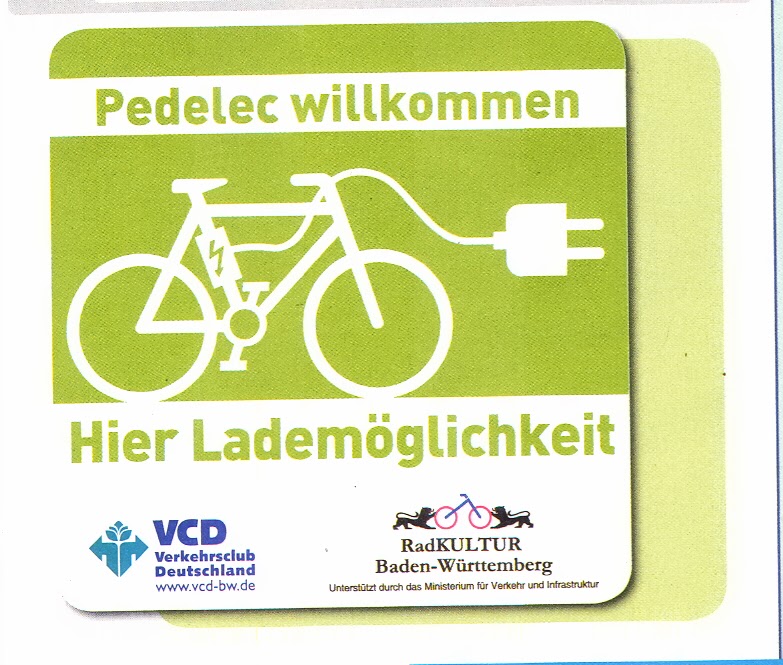
Whether it is a sign of the growing popularity of pedelecs or whether it is a clever marketing campaign I am not sure. The VCD is persuading cafes, hotels and restaurants in the Southwestern German province of Baden-Württemberg to offer free e-bike charging. The VCD is a German club offering the help that motoring clubs offer such as breakdown assistance, but also campaigns for environmentally friendly means of transport, such as cycling, trains and buses. It argues that  cafes and the like need not buy expensive charging equipment, a short row of plug sockets will suffice. Cyclists should bring their own charging leads. The argument is that there is no cheaper way of persuading a cyclist or even a group of cyclists to stop for another half hour and drink another apple juice. The sticker below is available free of charge from VCD offices in Baden-Württemberg. It is interesting that the local energy supplier in the neighbouring province of Rhineland Palatinate is offering a similar service. (See this blog 6 July 2013)


Tuesday, June 25, 2013

Radsalon Mannheim 2013

For several years now the City of Mannheim in conjunction with the chamber of commerce and the city's marketing agency has organised the Radsalon, an annual cycling festival with an exhibition. This is held in a square in the middle of the main shopping area of the city and attracts not only bike freaks but shoppers out to pick up some new clothes. Last Saturday (22 June 2013) stands included the ADFC - the German cycling club, a secondhand bike sale, a number of local and regional bike shops, bicycle manufacturers, an energy agency, the car sharing club, free bike checks - as part of the Baden-Württemberg provincial campaign to encourage cycling and VELOTransport - a government sponsored project to encourage the use of cargo bikes by families and by small businesses.
I would like to have visited the Riese and Müller stand with its cargo e-bike and electro- and normal versions of these exceedingly clever bikes, but we had very little time to spare. We were on the ADFC stand advising folk about buying cycling helmets, discussing the advantages of membership and giving out our tour programme.
The VELOTransport stand was next door to ours and I did notice the lads on the stand were kept busy with visitors. In a quiet five minutes I had a quick chat with both members of staff and looked at the five or six cargo bikes and trikes on the stand. The VELOTransport project is designed both to demonstrate the usefulness of cargo bikes to young families aiming to dump the car or small businesses who need to move small amounts of stuff in city centres where car parking is expensive and restricted. The stand offered hands-on experience of these bikes. The group had cleverly visited a wide range of events over the last year including the biannual German Protestant Church annual meeting, an Ideal Home exhibition and a caravan show, so did not restrict themselves to cycle exhibitions. As a back up the project offers a well thought out and extensive database of bikes, trikes and equipment for cargo carrying available in Germany (http://www.velotransport.de/). The website is in German unfortunately, but a lot of the links are to English language websites and if not there is always Google Translator.
The highlight of the Radsalon is a mass ride around Mannheim and Ludwigshafen, across the Rhine in  Rhineland Palatinate. This year over 650 riders on all sorts of bikes and trikes took place. The trip across the Rhine was cancelled because of a major fire in Ludwigshafen harbour.
Before the Ride
The smoke from the fire was visible from Mannheim


Wednesday, April 10, 2013

Charge your e-bike batteries for free while you absorb some culture in Baden-Württemberg!

The growing importance of the e-bike in leisure cycle touring is reflected in the decision of the Staatlichen Schlösser und Gärten Baden-Württemberg (Provincial Castles and Gardens Organisation, Baden-Wuerttemberg) to provide free charging stations for e-bikes from spring 2013. Visitors can utilise sockets directly or can hand over their bike batteries during their visit to the historic building or garden. There are charging stations in Heidelberg Castle, in the Ducal Palaces in Mannheim and Ludwigsburg, in Bebenhausen monastery / castle, in Urach Palace, and in Wiblingen Convent. In addition there is a group of sites around Lake Constance, a popular cycling area: in Schloss Meersburg, im Fürstenhäusle Meersburg, in Convent und Schloss Salem und in the fortress ruin at Hohentwiel. Visiting cyclists do need however to buy a ticket before plugging in their bikes or handing over the battery for charging.
Weikersheim Castle Copyright Landesmedienzentrum Ba.-Wü


Blog Archive