Showing posts with label ADFC. Show all posts

Saturday, August 22, 2020

Bicycles, Tandems and Recumbent Trikes on Trains in Germany and Neighbouring Countries Part 2: Joining and Changing Trains

If you wish to travel by train within Germany with your bicycles and/or tricycles and you have a choice of stations you can start from or need to change at, then either check out the station/s beforehand, if you can,  and/or download the Bahnhof live app. In Bahnhof live fill out the name of the station/s and the relevant page/s should appear. Click on Austattung and you will be shown a list of facilities. Look for the green barrier free wheelchair logo (Stufenfreier Zugang)  and Aufzüge (lifts/elevators) to be sure you don't have to carry your steed up or down flights of steps. There can be a lot of stairs, as this photograph of a station in Ludwigshafen shows. Just to explain the lift/elevator was temporarily out of order:

To further illustrate this approach: If you compare Augsburg and Munich (München) HbF - main stations with the app. Augsburg does not have barrier free access, but Munich does. It is much easier to change platforms in Munich. Things should improve in Augsburg in 2024!
It is recommended you should remove the bags before you load the bikes on the train. Don't do it until shortly before your train arrives. Some of the lifts/elevators are very narrow and your bikes with panniers are quite wide, so pop the bikes in these one forward one backward, so each pannier faces a front wheel.
Once on the platform check where the bike carriage (car) will stop. On bigger stations there will be diagrams showing the order of the carriages on a train. More often than not on local and regional trains the bike space is at one end of the train marked by bicycle logos on the side of the carriages. A WORD TO THE WISE (and the UNWISE) DON'T RIDE YOUR BIKE ON THE STATION, ON THE PLATFORM OR THE CONCOURSE. YOU CAN BE FINED 50€ ON THE SPOT. 

Take the bags off the bikes/tandems/trikes shortly before the arrival of the train. Depending on how easy it is to move and fold your trike do it before you pop on the train.  Unless the train is starting at your station, you may only have between two and four minutes to load the bikes/tandems/trikes. When the train arrives there may be a tsunami of people getting off the train. Let them off. If there is also another tsunami of travellers trying to get on the train, then politely but firmly make sure you can get on. Make sure you can get the other bikes in your party on the train and make sure you have got all your bags from the platform. Leaving the bar bag behind with your camera, passports and tickets could quite spoil your day.
Once you are all on the train: If you have booked a slot or slots look for yours and pop the bike in it. If you are on a local or regional train look for the conductor and check that it's OK for you to load your bikes/tandems/trikes. Obviously if you can do this before the train leaves it is better to do so, but if the train is coming from elsewhere you have two or four minutes to get your gear on the train, so after the motto it is easier to get forgiven than get permission, load your bikes. In any case do not block the entrances and exits. A bungee or a strap to keep bicycles from falling over is a good wheeze. It is usual for cyclists to help other cyclists, so muck in and don't let the side down. You may well be asked where you intend to depart the train so that bikes that will be first off are at the outside of the heap.
You should always try to travel outside the weekday rush hours, after nine am and before three in the afternoon. Unfortunately regional trains can also be busy on summer weekends. There are limits to the number of bikes that can be carried. It is the conductor's decision to let you stay on the train, so be polite. You have no rights, no say in the matter. Good Luck! 
We must stress that conductor/guards have the final say. We once chatted to a German conductor/guard in Wissembourg just south of French-German border. He told us that at Wissembourg Station he once had over 50 bicycles in his Diesel two car set with a maximum capacity of 2 x 12 bicycles. It was a Wednesday, a popular day for pensioners from the Ludwigshafen-Mannheim conurbation to cross over into the wine growing areas of the Rhineland-Palatinate and Alsace to cycle or hike. (Why Wednesday? The word is that Dr.'s surgeries are closed in the afternoon and so there is little to do.😎😎) The passengers refused to take their bikes off the train. The service to Neustadt an der Weinstraße is an hourly service and they all wanted to get home for their tea in time. He instructed the driver to leave; rang the railway police in Germany; the train crossed the border; stopped at the first halt and waited until the railway police who are also border guards arrived to reduce the number of bicycles on the train to safe levels.

Monday, June 08, 2020

Why don't cyclists stick together?

In the past we spent a fair amount of time cycling around the Alps. We noticed that if a motorcyclist sees a fellow candidate for the emergency room on a motor bike on a quiet road up high in the Alps, she or they give the other a cheery wave, without checking whether the other is riding an inferior motorbike or a moped. If cyclists meet the first thing many of them will do is to check what kind of bike the other/s are riding. There appears to be a division into:
  • road bikes,
  • touring bikes,
  • MTBs,
  • commuters including folding bikes and e-bikes
  • day trippers
Cyclists then basically greet people on the same type of bike. We in the past have had enjoyed seeing the looks on the faces of road men as we panted our way over the odd Swiss Pass on our Brompton folding bikes. There was no sign of recognition that we were fellow cyclists. This kind of snobbishness is typical for cyclists. Fine, the last thing you need on a busy city street in Amsterdam, Cambridge, Copenhagen or London is a greeting, but on a lonely road it is a friendly act.

There may well be an inverse snobbery as well. If I understood the history of the Kalmit Klappradklub in Maikammer, Rhineland Palatinate, Germany correctly, this came into being  when various local citizens were choked off by the basically wealthier ones among them boasting about their 27 and more geared super lightweight carbon fibre titanium mountain bikes. They planned and organised a race up the road to Kalmit the highest peak in the Palatinate Forest from Maikammer, Rhineland Palatinate on Klappräder the cheap single geared mass produced bicycle with 20" wheels. The race up Kalmit is an annual event where variously costumed riders set off up the 400m climb over 6km to the summit. It's great fun and I can recommend a visit on the first weekend in September. There are some keeny beanies who make it up the hill in respectable times, but the costumed majority take their time. A whole sport has now developed racing single gear Klappräder on various circuits.

Then there are at least three topics that divide cyclists:

  • Helmet wearing. Some of our fellow cyclists count the number of photographs showing helmet wearing or bare headed cyclists in club magazines and complain about propaganda for or against helmet wearing. Personally if I want to wear a helmet fine! If I don't, it is to quote the Germans "my beer", my decision. However I suspect if you want to found a new cycling club section then put forward a motion at a British cycling club's AGM that in future helmets must be worn on club runs. This only applies to the UK and Australia. In the USA helmets are worn without question. Odd actually, in the time of Covid-19 many groups in the USA feel that wearing face masks is somehow unmanly but every American cyclist I know wears a helmet when cycling without question. I suspect one is more likely to pick up a Corona virus when unmasked in a group than suffering serious head injuries when cycling helmetless.
  • Trailers It would appear that some of the cycling community feel that towing a trailer is letting the side down. I don't know why. I have yet to come across it.
  • E-bicycles. According to some of our cycling brethren if you ride a pedelec you are a traitor to the cause of zero energy transport along the lines of "e-bikers are not real cyclists!". This does conveniently overlook the energy needed to produce bicycles from ores or scrap metal. Then there is the suspicion that e-bikers are actually riding mopeds and are not exerting themselves sufficiently, or should that be suffering enough. We have joined the group of assisted cyclists. In my case after major heart surgery I suspect it would not be good for me to slog my way up hills. However normally we cycle on minimal assistance and I do not notice any difference when I turn the motor on at the lowest setting. When we hit a steep bit I push up the power.
Obviously although mud spattered mountain bikers with or without e-power, road racing types on a club run, commuters, families with children on cargo bikes, tourists, etc. etc. have different interests and aims, most of us are interested in safe cycling, adequate facilities, clean air and good investment by governments in cycling. If we speak with a joint voice we might have chance of being heard over the motor lobby and can convince politicians in spite of their longing to be photographed in hiviz waistcoats and a hard hat next to an incredibly expensive highway moving a traffic jam a few kilometres from one side of a town to the other.


Friday, October 30, 2015

Bike repair for schoolchildren

The Heidelberg branch of the ADFC, the German cycling club offers weekly repair sessions every Monday where young people can learn to carry out simple repairs on their bicycles. These free sessions - Schüler-Radwerkstatt on Mondays between 15:00 and 18:00 are led by four youngsters and the training officer of the ADFC Heidelberg.  These sessions give young people the chance to repair their bikes under instruction and thereby learn to carry out simple repairs to their bicycles. It strikes us as a good idea that could be taken up by bike clubs and youth groups elsewhere.

Friday, September 11, 2015

Emergency Services for Cyclists

Like a lot of cyclists over the age of 18 we also own a motor car. When we are travelling in the thing we know that if it starts to make funny noises, a tyre punctures or the gears stop functioning we can ring a motor club hotline and sooner or later a representative of the club or a contract garage will appear and repair the damage. Until recently these services were not available in Germany for cyclists. If your bicycle gears went belly up, you needed to walk or get transport to the next town or village to find a bike shop or if your bike was stolen, you had to find a bike hire station, etc. This service for cyclists has been available in the Netherlands from the ANWB for some time. I was pleased to read that the German ADFC is now offering a similar service (ADFC-PannenhilfePLUS) as an additional package to members for 11.90€ (individual) or 19.90€ (family) annually covering the EU and Switzerland and Norway. A 24 hour hotline will provide those insured with information about bike repair workshops and bike hire stations, send a sag wagon if the bike is damaged beyond repair or organise a return home. This applies to all bicycle problems except punctures. This could well be adopted by other bicycle clubs, even the CTC, the cycling charity. Then of course the various clubs could cooperate to make life easier for cyclists travelling abroad, but is this asking too much?

Sunday, July 26, 2015

How do bike years compare to people years?

We went by Brompton to Lorsch to a rally about the line of the new high speed railway line from Frankfurt to Mannheim. The plan is to run the line east and parallel to the A67 autobahn through a forest. In addition Deutsche Bahn plans to run goods (freight) trains along the line overnight. Many locals object to this project because of the damage to the local woods which are an important leisure area and because of fears about health problems due to noise pollution. There is a serious suggestion to submerge much of the route in a tunnel. We understand these fears, but also support any move to move goods transport away from roads to rail.
While we there we met various friends who are members of the ADFC (German Cycling Club), chatted to the odd soul on the stands, enjoyed Kaffee und Kuchen (coffee and cake) and listened to an excellent local amateur big band. It was a fairly typical summer afternoon in Lorsch. We set off for home and in the Viernheim Woods Judith got a stick caught in the chain tensioner. The chain left the pulley cogs and the drive train jammed. We had no choice but to turn the bike over, loosen the chain tensioner and get oily. We had almost finished when two of our ADFC friends appeared and enjoyed a little Schadenfreude. One of our famous Bromptons was giving us problems. We pointed out that the bikes were twenty years old. Then came the question, "How old is that in people years?". This we couldn't answer, but it struck us that if the Bromptons were cars, and both are about twenty years old, they would more than likely be sitting on a scrap heap rather than being ridden about.
 

Friday, November 28, 2014

Cyclist- and bicyclist-friendly accommodation in Europe


We wrote about the German Cycling Club's BettundBike.de/en website earlier, in 2013. It is an excellent website offering lists of cyclist-friendly accommodation (Hotels, pensions, guest houses, youth hostels camping sites) in Europe. The idea has spread into neighbouring countries.


In addition there are other sources of information in websites listing cyclist-friendly accommodation:
  • Austria Vienna Wien.info has 130 cyclist friendly hotels/pensions/guest houses on its books.
  • Belgium 
  • Croatia There seems to be no specific information available on cyclist friendly hotels but on the other hand we suspect that all the hotels in Croatia are cyclist-friendly.
  • Denmark The http://cyclistic.dk/en/ website has lists of cyclist-friendly accommodation in Denmark.
  • France In our experience all French hotels are cyclist-friendly and with one exception over about 35 years of cycling in France, we've always had somewhere to lock our bikes away, in the countryside in sheds and in the cities conference rooms or unused offices. 
  • Netherlands The http://www.allefietserswelkom.nl/kaart shows a map of the Netherlands with accommodation marked. By clicking on the map one links to the hotel and hostel websites. The website is in Dutch, but the accommodation websites often offer an English version. 
  • Poland There seems to be no specific information available on cyclist friendly hotels but on the other hand we suspect that all the hotels in Poland are cyclist-friendly. There are links to accommodation on http://www.poland.travel/en/cycling/cyclist--environmentalist/
  • Switzerland Check out http://www.veloland.ch/en/accommodation.html

Friday, May 09, 2014

Vennbahn: Cyclist-friendly accommodation in East Belgium

If you wish to cycle along the Vennbahn from Aachen, Germany to Trois Vierges, Luxembourg, then it will be good news that Tourist Authority of East Belgium in cooperation with the LVI, the Luxembourg Cycling Club and Velosophie tourism consultants in Luxembourg has organised a Bed and Bike guide similar to the German ADFC Bett und Bike Guide and the Luxembourg LVI Bed and Bike Guide. The guide will lead cyclists to cyclist-friendly accommodation along the 850km of cycle routes in German speaking Belgium. The easiest way of accessing the guide for non-German speakers is to log onto the English version of the German www.bettundbike.de by clicking on the Union Flag upper right. Belgium can be found under Countries. We have yet to find anything similar for the UK, pity really.

Sunday, January 05, 2014

Comparing ADFC Route Quality Ratings

The ADFC, the German cycling club has started a rating system for cycle routes. These are mainly in Germany but a few are in Austria. We wrote about these last year. Since then more routes have been added. We will write about these shortly.
We were glad to see that the Tauber Valley Classic Route along the floor of the valley received a five star rating, but surprised to see that the Romantic Road Cycle Route only received three stars. The Romantic Road joins the Tauber Valley Classic Route for 70 of its 420km. We looked at the results in detail:
We have cycled both routes often. What struck us was that the Romantic Road got much lower values in four areas:
  • Ease of riding. It is true that the Tauber Valley Route has just about no barriers with only one flight of steps and thus deserves the 5 stars. There are some barriers on the Romantic Road. It is the longer route by far.  We don't think it deserves such a low marking.
  • Surface: The Romantic Road has some stretches that are not tarred, whereas the Tauber Valley route has far fewer, but the former is much longer.
  • Sign posting. We don't think the Romantic Road sign posting is poor. We have never had problems following the route. Sign posting can be improved easily, but it is the responsibility of local authorities, rather than the Romantische Strasse Touristik Arbeitsgemeinschaft GbR, the tourism body responsible for marketing and coordinating activities along the whole route.
  • The route design. This has a low weighting and it is not easy to assess.
We suspect that there will be improvements in the above areas which will improve the ratings of the Romantic Road Cycle Route.

Saturday, November 02, 2013

An idea for cycle clubs

The ADFC section in Ottersweier, a village south of Karlsruhe in the Rhine Valley, organises free bike parking for the annual Dorfbachfest, a typical jolly German weekend fest with grilled sausages, beer and umpah bands. The village council supplies a car park and galvanised wire builders' fencing. The ADFC supplies volunteers to guard the bike park, organises a ticketing system and has an information stand. The chairman of the ADFC group and the organiser of this action wrote that cyclists are overjoyed to find secure parking and it is a good way to acquire new members.
I realise that do's with umpah bands and beer are few and far between in Britain, but there will be large numbers of cyclists to watch le Tour next year in Yorkshire and there will be more mass cycling events in London, so CTC local groups could help themselves and the cycling community by laying on bike parking at various events.
5 January 2014: I suppose it could even be seen as one of the ideas supported by David Cameron in the Big Society project.

Friday, August 23, 2013

Ghost riders and other problems

One of the problems we have as cyclists are other cyclists who break the traffic laws for their own convenience,  e.g. riding through red lights, on pavements and footpaths, on roads when there are adequate cycleways adjacent to the road and riding the wrong way on cycleways. I was horrified to see two cyclists riding around the Viernheim bypass on Sunday morning. There is an excellent, well marked, fast cycleway adjacent to the road and under German law what these two did was illegal and considering that the speed limit on the bypass is 70kph, dangerous and daft. I always feel that some cyclists feel as they are travelling in a non-polluting manner, they are on the moral high ground and can do what they want. These characters do themselves and the rest of us cyclists no good at all. They provide ammunition for the protagonists of the Lycra Lout ideas. They put themselves at risk and when they cycle on a cycleway on the wrong side of the road they put other cyclists at risk.
Geisterfahrer (Ghost Rider) is the German for someone cycles the wrong way along a cycleway. I was pleased to see that ADFC Lübeck has started a campaign to illustrate the dangers of this practice. There is a film on YouTube about the opening demo (http://www.youtube.com/watch?v=RjbJFWVUyXk). The film is in German but language is not needed to understand the film. It might be a source of ideas for local groups in other countries. In fact, having cycled round Mannheim on Wednesday afternoon, it would be a good idea in Mannheim too !

Tuesday, June 25, 2013

Radsalon Mannheim 2013

For several years now the City of Mannheim in conjunction with the chamber of commerce and the city's marketing agency has organised the Radsalon, an annual cycling festival with an exhibition. This is held in a square in the middle of the main shopping area of the city and attracts not only bike freaks but shoppers out to pick up some new clothes. Last Saturday (22 June 2013) stands included the ADFC - the German cycling club, a secondhand bike sale, a number of local and regional bike shops, bicycle manufacturers, an energy agency, the car sharing club, free bike checks - as part of the Baden-Württemberg provincial campaign to encourage cycling and VELOTransport - a government sponsored project to encourage the use of cargo bikes by families and by small businesses.
I would like to have visited the Riese and Müller stand with its cargo e-bike and electro- and normal versions of these exceedingly clever bikes, but we had very little time to spare. We were on the ADFC stand advising folk about buying cycling helmets, discussing the advantages of membership and giving out our tour programme.
The VELOTransport stand was next door to ours and I did notice the lads on the stand were kept busy with visitors. In a quiet five minutes I had a quick chat with both members of staff and looked at the five or six cargo bikes and trikes on the stand. The VELOTransport project is designed both to demonstrate the usefulness of cargo bikes to young families aiming to dump the car or small businesses who need to move small amounts of stuff in city centres where car parking is expensive and restricted. The stand offered hands-on experience of these bikes. The group had cleverly visited a wide range of events over the last year including the biannual German Protestant Church annual meeting, an Ideal Home exhibition and a caravan show, so did not restrict themselves to cycle exhibitions. As a back up the project offers a well thought out and extensive database of bikes, trikes and equipment for cargo carrying available in Germany (http://www.velotransport.de/). The website is in German unfortunately, but a lot of the links are to English language websites and if not there is always Google Translator.
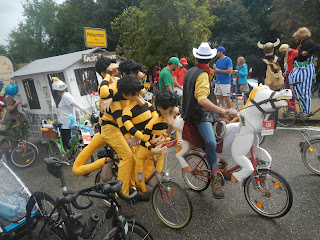
The highlight of the Radsalon is a mass ride around Mannheim and Ludwigshafen, across the Rhine in  Rhineland Palatinate. This year over 650 riders on all sorts of bikes and trikes took place. The trip across the Rhine was cancelled because of a major fire in Ludwigshafen harbour.
Before the Ride
The smoke from the fire was visible from Mannheim


Wednesday, April 03, 2013

More and better GPS devices

According to a report in the Südhessen Morgen, 2 April 2013 GPS devices for outdoor use are selling like hot cakes. It is no longer just  nerds who are buying the instruments but also normal cyclists who want to have a quick tour at short notice.  Thomas Froitzheim of the Allgemeiner Deutsche Fahrrad Club (ADFC), the German cycle touring club, pointed out that newer systems offer the comfort of the navigation systems for motorists combined with outdoor touring maps. One enters either a target or a time limit and the GPS device works out a route, often using an audio system to describe which way to go. Obviously there are still buy instruments available where the cyclist or walker needs to work out a route on his or her PC which is then transferred to the GPS device. This stage will be a critical point for us, as a number of these instruments and their map collections only recognise Microsoft Windows® systems, which is not much use for those sensible souls who use Apple Macintosh computers.
The more modern GPS devices help the errant cyclist who leaves the suggested route to return to the path of righteousness, whereas the older systems show the route and  the cyclist's position letting him or her find their way back. However, Thomas Froitzheim thinks that both the older simpler and the newer systems suffer from content quality. There is not yet enough information about the quality of cycle routes built into the system. We think it would be better if cyclists could specify the most scenically interesting route or the one with the best tea rooms, etc. This could be the app the cycling world is waiting for.

Sunday, March 10, 2013

GPS, iPad, iPod, iPhone maps

BVA,  Bielefelder Verlag the German Cycle guide and map publishers have converted a number of their regional ADFC maps (1:50 000 or 1:75 000) for the iPad, iPod or iPhone. Other regional maps are in  process of being converted. The app can be downloaded from the iTunes. We don't know when and if the company is going to offer an app for Google phones and produce digital version of the smaller scale ADFC touring maps. We have enquired by eMail at BVA, but have not received an answer.

Friday, July 06, 2012

Bromptons!

We've changed our ADFC (German Cycling Club) section and are now members of the Mannheim group. We live in the Hessian town of Viernheim which is bordered on three sides by Baden-Württemberg. Normally in the ADFC one is assigned membership depending on where one lives. In our case we should be members of the Bergstraße County group whose centre lies 20 km to the north with inconvenient public transport links. However Mannheim is 12 km away and there is a reasonable tram system between Viernheim and Mannheim. It seemed more logical to change sections and after about twenty years we finally got round to it.
We went to Mannheim two weeks ago to the annual Radsalon - a mixture of market, exhibition and a bicycle parade through the twin cities of Mannheim and Ludwigshafen and helped on the ADFC stand.  We were supposedly helping people choose the best fitting cycle helmet, although as we had taken the Bromptons we ended up as ever discussing the merits of the über-folding bike and the advantages/disadvantages of folding bikes in general.

Saturday, June 16, 2012

Mannheim City and Province encourage bicycle mobilty

The Baden-Württemberg government has started a project to encourage sustainable local transport in four cities in the province: Lörrach, Mannheim, Stuttgart and Tübingen. The cost of this project (€3 million) is financed by the tax on motor fuels.  Cyclists can take their bikes today to a mobile service centre parked on the Mannheim Wasserturm (Water Tower) near to the main shopping streets of the town to have their bikes checked by an expert free of charge. The team will be there next week (23 June, 2012) on the pedestrian zone as well, as part of the third Mannheimer Radsalon, a fair with 20 exhibitors and a bike parade.
If you are passing in the afternoon we should be on the ADFC stand for a couple of hours.

Wednesday, June 06, 2012

A motor club gets in on the act.

British and US cyclists have probably heard of the ADFC, the Allgemeiner Deutscher Fahrrad-Club. A word for word translation of the name would be the General German Bicycle Club. The British equivalent organisation is the CTC, the Cyclists' Touring Club to give its old name or as the organisation prefers to call itself,  The UK's national cyclists' organisation. Some of us prefer the old name which we think is clear, but both names describe the function of the club, whereas the "General" in the German club's name is superfluous. Why did the German club give itself a rather odd name when it was founded as part of the Green movement twenty-five years ago? It was intended to cock a snoot at the older well established German motoring club, the ADAC, Allgemeiner Deutscher Automobil-Club. This organisation which as a supporter of motoring was a bête noir of the Green movement in Germany at that time. The ADFC has had a successful time since then and plays an important role in cycle touring in Germany for cyclists and those in the know.
The ADAC still acts as though there is an unlimited supply of oil in the world, but at the same time it has recognised that bicycles, especially e-bikes have an important role in short distance mobility. The organisation has taken over the role of its younger competitor in this area and its speakers are often called upon to present short features on on e-bikes on German TV. Its magazine "Motorwelt" has just devoted four pages to e-bike tours.
In addition the ADAC has brought out an app called Fahrrad Tourenplanner Deutschland 2012 - Bicycle Touring Planning Germany 2012 with 1500 bicycle tour suggestions. The ADFC had better not rest on its laurels.

Monday, January 18, 2010

Plans for the summer

On Saturday we are due to go to a knees up organised by the regional ADFC (German cycling organisation, similar to the Cyclists' Touring Club in the UK and the League of American Bicyclists). "Knees up" is probably the wrong term. We are going to drink coffee and eat tiramasu, rather than brown ale and jellied eels. We are due to discuss our projects and cycling last year and the plans for this year rather than standing round the Joanna* singing about "My Old Dutch"* and sending out for a Ruby* afterwards. I have noticed that the cycling blogs too are in this reflective and planning mode. It is a bit too cold and/or icy to get out on the bike, so it is a good time to settle down, report and do some thinking. Judith has already reported on our year in the last blog, so what are we debating doing this year? Well, our Rhine II book is still selling quite well and the Ruhr is one of the European cultural capitals this year, so a trip to the Lower Rhine is on the cards. We have talked for some time about cycling the Weser Cycle Route. We enjoyed our time up in Schleswig-Holstein very much and the routes up into Denmark are also very interesting. Maybe this is the year we go down to southeastern Bavaria to look at the Pope Benedict Route. There are large chunks of eastern Germany, the Oder-Neise Route, for example, we would like to visit. We definitely want to carry on with our day trip series in the Rhineland Palatinate, published by Guide Gecko. There is even a 420 km mountain bike route through Alsace which could well be good fun if we can get fit enough. We will have to see.

*For any non British readers:
"Knees up" is a raucous party. The name derives from a 1938 popular song "Knees up Mrs Brown".
"Joanna" is Cockney rhyming slang for a piano.
Dutch is London slang and is an abbreviation of Duchess, i.e. My Old Dutch is my wife. It is another popular song.
A "Ruby" is Cockney rhyming slang for a curry from Ruby Murray, a 1950's pop singer.

Sunday, April 15, 2007

Finding somewhere to lay your head

I am loathe to mention the products of organisations, other than our own or the one we are writing a book for, but I think I need to make an exception for one series of Esterbauer Books: “Bett und Bike”, which includes Bed and Bike Flandern (Flanders) (ISBN 978-3-85000-255-7). The ADFC, a German cyclist club laid down a list of specifications some time ago for bike friendly hotels. Hotels wishing to join the scheme have to agree to provide lockable bike accommodation, carbohydrate rich breakfasts for cyclists, accept folk for one night, public transport information and other similar things. This does mean that the smaller B&Bs where cheapskates like me prefer to stop, cannot match all of these criteria and so don't appear whereas the major chains and more expensive houses can offer all of these facilities, do. I would personally prefer to include say the hotels/guest houses/B&Bs that take folk for one night and encourage people to offer some of the other facilities. I do have the impression that the ADFC approach is also designed to improve the public image of cyclists as not always stopping in B&Bs and Youth Hostels. The latter however are included in the German volumes. The books cover Flanders, i.e North Belgium, all of Germany and a few hotels in Luxembourg. You can check out the accommodation lists by going to the ADFC website (www.adfc.de) but you will need some German. The Flanders book also does not mention the Trekkershutten which are simple wooden huts with four berths and cooking facilities mainly on commercial campsites. They cost around €40 a night. You need to take a sleeping bag, but that's all. We have used them and they are superb value for money. (www.trekkershutten.nl. Click on the “Zoek een Hut” button to see a map of where the Dutch ones are and then click on the Belgian flag at the bottom to see the ones in Flanders.) Flanders is a great place to go cycling. Lots of history, some but not too many hills and the beer is good too.
The idea has also spread to Switzerland. Veloland Schweiz the Swiss cycling Foundation has produced a similar guide called “Velo & Bett” (ISBN: 3-85932-522-1) covering the whole country. You can find the same information on the Veloland Schweiz website (www.cycling-in-switzerland.ch) as well.

Blog Archive