Friday, September 22, 2017
Electro Cargo Bikes for Hire in Cologne
I came to Germany about 40 years ago. At that time most German young men drank beer. If a visitor came round it was usual to offer them a bottle of beer, so every two or three weeks one would buy a crate of beer. In those far off days one normally used a car in order to drive to an out of town supermarket to pick up the beer. Trolleys, bike trailers and cargo bikes were unknown. I did not have a car so would walk round to a local shop and stagger back with 20 bottle crate causing my fingers to gradually numb. These days we drink about a crate of beer annually and now there is a possibilty of hiring an electro-cargo bike, in Cologne at least: www.donk-ee.de.


Friday, September 08, 2017
Beer soft drink mixtures for cyclists Part II
We spent a week in Oberstdorf way down south in Bavaria recently and I tried a Russenhalbe. This is a mixture of Weizenbier and lemonade. Avoid it like the plague. It is dreadful.
Friday, September 01, 2017
Reducing air pollution in city centres. Finding room for cycle ways in cities.
Mannheim like many German, nay, European cities is looking to the bicycle as a way to reduce air pollution levels. The idea is to reduce the number of not only diesel powered vehicles on the road in the city centre. New cycle ways are planned, both in city streets and as bike-bahns, bicycle super highways. There are a number of new cycle ways in Mannheim and those that are in city streets take up room that could be utilised by motor traffic, shock horror! Opposition to these measures normally fall in to two classes, either suggesting a different, more inconvenient route along quieter city streets running parallel to a direct route or the end of civilization as we know it argument, that the measures will make shopping in the city centre so inconvenient, that customers will go elsewhere. The latter argument falls down when one notices that many people, us two for example, use public transport to visit the city to buy clothing and outdoor gear. If we decided to buy furniture or white goods - fridge or washing machine we'd have it delivered.
The one thing that most of the petrol heads miss is that although they might be slightly delayed driving their status symbol into Mannheim to find a parking spot or coughing up the tram fare to park the beast, there will be 10 or 15% fewer cars on the road. This will mean the delay will be less. In view of the air quality in cities all the world, there are going be restrictions on the use of cars and we all might as well get used to them.
The one thing that most of the petrol heads miss is that although they might be slightly delayed driving their status symbol into Mannheim to find a parking spot or coughing up the tram fare to park the beast, there will be 10 or 15% fewer cars on the road. This will mean the delay will be less. In view of the air quality in cities all the world, there are going be restrictions on the use of cars and we all might as well get used to them.
Friday, August 25, 2017
Vacation Medical Insurance for Trips to Great Britain
This note was triggered by meeting two US Americans on our walking trip through Northumberland. They had been cycling, but one of them had an accident and had injured her knee. She refused to go to the local National Health Service hospital to have the knee examined and skyped her Dr. in the USA to have a long distance investigation. The couple had several weeks more vacation to "enjoy". We enquired and were told treatment would then follow in the USA, but the lady was in pain. Whether the two had something against socialised medicine or whether they had no vacation medical insurance so were worried about the cost of treatment we didn't enquire.
We have known cases where visitors from outside of Europe have come to Germany without medical insurance and it can be quite expensive. Treatment in Britain is cheaper, but… Cyclists visiting Britain from outside the EU, however should take out a vacation medical insurance. If anything happens it is cheaper than being without an insurance. British public hospitals charge non residents which wasn't formerly the case, but these days the hospitals want to see an European Health Insurance Card (EHIC) or a credit card. Just don't ask about dentists, who are largely private in the UK. An ankle or knee injury could well make a serious hole in £500. Short term medical insurance cover costs less than this.
Visitors to Britain from countries either in or associated with the
European Union can receive an EHIC which
gives the holder medical treatment in the various countries of the EU
under the same terms as an inhabitant of the country they are in. At the
moment this applies to UK citizens as long as the country is in the EU.
What will happen after BREXIT is not clear.
Friday, August 18, 2017
Free cargo bike loans in Mannheim, Germany
Following the example of other German cities Mannheim now has a number of cargo bikes that one can borrow. Details in German on „www.lastenvelomannheim.de“. It's a chance to use one occasionally or try one out before buying one.
Friday, August 11, 2017
Changing trains in Hamburg, Germany
If you are travelling south from Hamburg by train rather than using the main railway station, Hamburg Hauptbahnhof consider using the Dammtor station just to the north. The Hauptbahnhof is very busy, whereas Dammtor is much quieter. Just check that your train does stop there before heading south using www.bahn.de. Especially if you are going to put a bicycle on the train Dammtor is much easier to use.
Friday, August 04, 2017
Bicycle of the week?
We subscribe to a digital version of the "Observer", a British Sunday newspaper. The newspaper features a Bicycle of the Week. More often than not these are expensive thin tyred road bikes without such luxuries as mudguards or baggage racks meaning they are useless as commuter bikes although they are often described as such. The "Observer" is not alone in this. Most newspapers review motor cars that are outside the financial comfort zones of their readers. I think I should stop reading these bicycle reviews. It will be better for my blood pressure. For some reason unknown last weeks bicycle of the week is a motor bike, OK without a petrol engine, but fitted with an elecric motor: a Neematic FR/1. This ticks all the newspaper boxes: it's expensive, Price: £7,075. It probably needs a motor bike licence to ride it, at least in Germany with its top speed of 50mph (80kph). It's basic purpose in life is to be popped on the back of a car and ridden offroad skidding round forest tracks as though one is in the Utah backwoods. It's heavy though, 50kg. There are no points where one can fasten a bag, so you need to carry your gear on your back.
What worries me is that at the moment about all these electric mountain bikes is that we spend a modest amount of time hill walking in the Odenwald and in the Pfalzerwald, where the Germans who consider that one is roughing it, if there is no chance to munch a sandwich, drink a Weizenbier, a cider or a glass of wine once one has ascended the summits, have built inns and mountain huts on the tops. In the past one saw the odd mountainbiker up the top, as it was hard work climbing three or four hundred metres from the plains, but with electric oomph there are more and more bikers in the restaurants. Even if they lay off the Dornfelder Rosé and most off them do, they can still let the pig out on the way down as though they were taking part in the Trans Provence race. This is what mountain bikers do and it bothers me. Normally the rules are that the mountian bikers should follow the wider more gradual forest roads, but for some of them it's more fun to transfer to the paths that we walkers use. OK if I am walking uphill, I can keep my winkers open to spot any would be downhiller barrelling down the narrow paths, so I can shout "BIKE!" and jump into the bushes, hoping that she who must be obeyed has heard me and followed suite. Walking downhill is more difficult. One needs to look round like a WWII fighter pilot in a dog fight. Matters aren't helped by the advertising for the Neematic which shows a mountain biker skidding around corners burning off adrenaline. It does not encourage responsible cycling in woods packed full of families and pensioners rambling uphill and down dale.
Friday, July 28, 2017
Mudguards/Fenders
Recently I have come across three examples of bikes that in my opinion are not fit for purpose as touring and commuter bikes: two hire bikes used by a pair of US Americans in Scotland; a bike offered as a prize in competition to celebrate 200 years of the bicycle and "The bicycle of the week" in a British Sunday newspaper. I checked the bicycles of the week feature and realised that over 90% of the bicycles shown were without mudguards although they were intended to be used for commuting and/or touring. I am sorry to tell you this but in Britain it rains a lot, not as much as is popularly thought, but one can normally reckon with wet roads from time to time even in summer. Your tyres will then spray mucky water at you and your bike. If you are a fair weather commuter or tourist, or even just use your bike as a fitness machine then a bike without mudguards does give you a sportier image, but if you are going to use your bike as a means of transport then think seriously about mudguards.
Friday, July 21, 2017
Booking a touring holiday in Franconia, for example or in the far east of Germany
Where do you start planning a cycling holiday in Germany? You can, of course, fly to say Friedrichshafen and then follow the Rhine to the Dutch border finding your finding your overnight accommodation as you drift downstream. This is not a problem if you are in a small group and you start to look for your acommodation at around 4pm.
If you would like to get off the beaten track or you are worried about your lack of German, then check out the offers such as:
Those shown on www.mainradweg.de on the River Main between Bamberg and Aschaffenburg. This self-guided pre-booked trip costs 519€ pp for 8 nights with breakfast. Contrary to what "The Guardian" writes restaurant meals in Germany are less than in the UK.
The Fürst-Pückler Weg - 500km through Eastern Germany. This self-guided pre-booked trip costs 659€ pp for 10 nights with breakfast. http://www.radreisepartner-spreewald-lausitz.de/
The Spreewaldradweg - 420km through Eastern Germany. This self-guided pre-booked trip costs 399€ for 6 nights with breakfast.You end up on the edge of Berlin and could then spend a day or two there and follow the route round the wall, the former border with the DDR. The website is www.spreewald.de and it is in English.
Friday, July 14, 2017
MTB Trans-Odenwald Tour
Follow in the footsteps of Wagner's heroes like "Siegfried - The Killer of Dragons" on a mountain bike rather than a horse. How do carry your sword? We are not mountain bikers, preferring to use map reading and thinking to avoid hills. This trip is on offer by one of the bike shops in Lorsch, south of Frankfurt am Main. It should be possible to fly out on an early morning flight to Frankfurt International and followed by a train to Lorsch to reach there in time to join the group. You will experience the Odenwald, one of the German middle sized mountainous or hilly areas. From Lorsch in the Rhine Valley, you cross the Odenwald almost to the Bavarian border and back across the Neckar to Lorsch. The bike shop organises the hotels, baggage transport, the sag waggon and offers technical support. The ice cream shops in Lorsch are something else. After your ice you can catch an evening flight back to Britain to go into work on Monday morning.
The requirements:The trip is only really suitable for fit, technically competent mountain bikers, but you can cheat by using a MTB e-bike. The trip is four consecutive days with a total of about 230 km and 4,000 m. Bike hire is also a possibility.If you are interested drop the organisers an email under info(at)odenwaldbike(dot)de.
The requirements:The trip is only really suitable for fit, technically competent mountain bikers, but you can cheat by using a MTB e-bike. The trip is four consecutive days with a total of about 230 km and 4,000 m. Bike hire is also a possibility.If you are interested drop the organisers an email under info(at)odenwaldbike(dot)de.
Friday, July 07, 2017
Radweg Deutsche Einheit - German Reunification Cycle Trail
The Radweg Deutsche Einheit - German Reunification Cycle Trail was initiated in 2015 by the German Minister of Transport and Digital Infrastructure, Alexander Dobrindt. It runs from the previous capital, Bonn, the "Bundeshauptdorf" - "Federal Village" as it was known, to the present capital Berlin. It is designed to show how reunification was achieved and what has happened in the 25 years since. Unlike most German cycle routes which are planned by a province, sometime acting together with another province, this was the work of the federal government. It is about 1100km long and offering some climbing as it does not follow a river like many of the major German cycle routes. Perhaps because of this plans are in place to install e-bike charging points at the stopping points near the 100 or so highlights en route. These stopping points "Radstätte" offer information, free WLAN, charging points not only for for e-bikes and mobiles, digital information vis touch pads, bike racks and, in some cases, baggage lockers. Much more information can be found under https://www.radweg-deutsche-einheit.de/, in German only unfortunately.
Friday, June 30, 2017
Cycling Holidays in Alsace
A number of outdoor centres, holiday villages and youth hostels in Alsace cooperate to offer holidays across Alsace. You can if you wish help rebuild a mediaeval castle using authentic methods, go canoeing, learn or brush up your French and German, or hike. However the cycling trips would be of more interest to the readers of this blog: cycle touring in the North of Alsace or mountain biking along the Vosges Mountains. Much more information can be found under http://www.aja-tourisme.fr/en. If you looking for a holiday with children or young adults this could well be a solution.
Friday, June 23, 2017
Cycling in Alsace
The French are gradually installing touristic cycle routes across France. For many years if you saw a tourist cyclist in France he or she would be a foreigner. The French either used a rusty ladies bicycle from the 1920s to cycle beret-wearing to the boulangerie pick up a baguette or two, or they wore a helmet, sausage skin shorts and Lycra® tops on a road bike in an attempt to get fit enough to recreate the glory days of Le Tour, when the French won, i.e. sometime ago. French cycle route planning was to issue maps put out by central government showing where it was intended to have cycle routes with no timetable for completion. Alsace was always somewhat of an exception to this as the Germans came over the border to cycle and enjoy a French way of life - very strong coffee, eclairs and vin rouge in an area where many people understand German, Alsace has also benefited from this discovery that cycle tourists are a good source of tourist euros and new routes have had signposting, etc. installed. For many years the only route that was signposted was the Rhine Route on the left bank of the Rhine between the French border in Lauterburg/Lauterbourg and the Swiss border in Basel/Basle/Bâle. Nowadays the Marne Rhine Canal towpath from Strasbourg towards Sarrebourg, the Saar Coal Mines Canal from Gondrexange north towards Saarbrücken, the Alsatian Wine Road Cycle Trail and the Rhone Rhine Canal from Mulhouse to Belfort are well signposted. There is more information on www.cyclinginalsace.com in English. The Alsatian Tourist authorities produce an excellent printed map of Alsace which includes lists of firms offering bicycling holidays and bike hire. Drop a postcard to Comité Régional du Tourisme d'Alsace, 20 A rue Berthe Molly, 68005 Colmar, France or an email to crt(at)tourisme-alsace.com.
Friday, June 16, 2017
Beer soft drink mixtures for cyclists Part I
Many continental beers at 5% alcohol content are stronger than British draught beers at 2% alcohol. As in Britain it is usual for cyclists especially to dilute their beer with lemonade. However what do you ask for? Asking for a shandy in a Munich beer hall will get you some funny looks and no shandy.
Here is a list of the names that various dilute beer mixtures are called:
The easy one for our American cousins in Britain is Shandy, a mixture of about 50% beer and 50% lemonade. It would appear that our US friends drink Shandygaff which is the same thing. One of the most refreshing drinks of this type is a Ginger Beer Shandy, which could well become an export hit in post-BREXIT Britain. This too is a 50:50 mixture, but note it is a Ginger Beer not Ginger Ale. Since most beer lemonade shandies come pre-bottled these days Ginger Beer Shandy is not easy to find.
In southern Germany you ask for a Radler - a cyclist and in the north you ask for an Alsterwasser if you want a beer lemonade mixture - the Alster is the lake in the centre of Hamburg. However in some parts of Bavaria, but do not ask me where, a Radler is known as a Russ. On the River Elbe the familiar beer lemonade mixture is called Ententeich or Entenpuhl - duckpond. On the River Weser in the northwest of Germany the beer lemonade mixture is called Fliegerbier - Pilot's Beer. In and around Münster in Westphalia the locals drink a beer orangeade mixture called Wurstwasser - sausage water. Why, I don't know. I drank it once on a very hot day in the winegrowing area of the lower Mosel Valley. It was all the pub had. I suppose it was really twice - for the first and last time. If you are in Berlin in summer ask for a Berliner Weisse (German: Berliner Weiße) mit Schuß which is a cloudy, sour, white beer of around 3% alcohol which is coloured with a shot of Himbeer raspberry or Waldmeister green artificial woodruff cordial. In north-eastern part of the former German Democratic Republic a beer raspberry flavoured soft drink mixture is known as a Potsdamer.
In Austria you ask for an Almradler a mixture of beer and Almdudler. The original Almdudler is a sweetened carbonated soft drink made of herbal extracts. Almdudler is the "national drink of Austria". In the western Austrian province of Vorarlberg you need to specify whether you want your beer diluted with lemonade Süsses Radler or with mineral water Saures Radler.
Dutch cyclists drink Sneeuwwitje - Snow White, a beer lemonade mixture but don't ask me how you pronounce it.
The Belgians around Antwerp call for a Tango - a beer with cola when they wish to dilute their excellent beers.
In Switzerland and in Luxembourg one asks for a Panaché (from the French panacher meaning to mix). If you wish to dilute your beer with cola then add the word "coca"- Panaché coca. In the Saarland, the German province, where French is the first foreign language taught in schools, one asks for a Panasch to obtain a lemonade beer mixture.
One can, of course, use non-alcoholic or low alcohol beers instead of a full strength beer. If you are not taken with the flavour of alcohol-free beers, this is an excellent way of disguising their too hoppy flavour.
These days a lot of German breweries like those in the UK pre-mix Radler. You'll get a bottle of Radler rather than a mixture of lemonade and draught beer.
If when you are touring in hot weather you hit a wall of tiredness we find a quick lift is offered by a cola-orangeade mixture known in most of Germany as a Spezi, but in Mannheim and district as a Kalter Kaffee - cold coffee.
Friday, June 09, 2017
NSU Bicycle Museum Neckarsulm Germany
Somehow we've missed the Deutsches Zweirad und NSU-Museum near Heilbronn in the past. I supect we were put off by the NSU connection. NSU built bicycles, motor cycles and cars including those with Wankel motors. The museum features however 400 exhibits in 2000 square metres. The bicycles exhibited range from the 19th Century to the present day, from the hobby horse to the e-bike.
The address: Deutsches Zweirad und NSU-Museum, Urbanstraße 11, 74172 Neckarsulm. The museum is signposted from the entre of the town. It is a short walk from Neckarsulm railway station through the park to the former Deutschordensschloß. The website in German offers an impression of the museum: http://www.zweirad-museum.de/.
Entrance costs 6 € for adults, 5 € for seniors and 3 € for students. Children under 6 get in free. The museum is open Tuesday to Sunday from 10:00 until 17:00. It is also open on public holidays if they fall on a Monday.
Friday, June 02, 2017
Bikes for high schools
We written before about the Albertus-Magnus-Schule in Viernheim here. The school took part in a competition organised by the Integrierte Verkehrs- und Mobilitätsmanagement Region Frankfurt and the Arbeitsgemeinschaft Nahmobilität Hessen (two local government organisations in the field of mobility) last year. Both staff and schoolchildren were encouraged to cycle as far as possible. The school was second in the competition for the most kilometres and first in the competition for the most participants. It won 1250 Euro and invested this in five new bikes for the school bike pool. The bikes can be borrowed in case a class is going to baths in the centre of town or one of the club sports facilities. Already the bikes are well used. Congratulations are due to the school.
Friday, May 26, 2017
Cleaning your bike
I worked for many years for an engineering society that organised the world's largest chemical engineering exhibition. I worked on the society's stand at the triennial exhibitions and I noticed, in addition to the guests who wandered from stand to stand collecting information, there were always guests carrying a briefcase packed with brochures who wished us to be interested in their ideas. During the bicycle parade after the recent 5. Nationaler Radverkehrskongress (5th National Cycling Conference) in Mannheim, I cycled next to another delegate who had a bag full of brochures and we discussed automatic bike washing. It turns out he has connections to a small company that has developed a bike wash.
The bike is put in a box 2.3m x 0.8m x 1.3m which is equipped with rollers to take the bicycle. The bike wash needs a source of mains electrical power and water. During the wash cycle dirt is loosened by ultrasound. A wash takes about 0.1L of water. The wash cycle takes three minutes. This would suggest it would take about five minutes to wash a bicycle. The bike wash comes on four wheels and can be easily moved. I have no idea how much the device costs either to buy or to rent. One needs to contact the manufacturer to find this out, but assuming it is reasonably priced it strikes me it would a capital wheeze if say
could lease or buy a bike wash they could trot out on various occasions. In the case of a bike shop it could be an added plus that each and every bike would be washed before inspection or repair.
The manufacturer's website is clean-your-bike.com. It is a German company, but the website is in English and German.
The bike is put in a box 2.3m x 0.8m x 1.3m which is equipped with rollers to take the bicycle. The bike wash needs a source of mains electrical power and water. During the wash cycle dirt is loosened by ultrasound. A wash takes about 0.1L of water. The wash cycle takes three minutes. This would suggest it would take about five minutes to wash a bicycle. The bike wash comes on four wheels and can be easily moved. I have no idea how much the device costs either to buy or to rent. One needs to contact the manufacturer to find this out, but assuming it is reasonably priced it strikes me it would a capital wheeze if say
- an event organiser for MTB, cycle cross, bike parade or even road race events,
- a political party such as the Greens,
- a bigger bike shop
- a national bike club such as Cycling UK
- or a city council
could lease or buy a bike wash they could trot out on various occasions. In the case of a bike shop it could be an added plus that each and every bike would be washed before inspection or repair.
The manufacturer's website is clean-your-bike.com. It is a German company, but the website is in English and German.
 |
| At work during the 200th anniversary celebrations of the first trip by a two-wheeled vehicle |
Friday, May 19, 2017
Winter Cycling
We visited the 5. Nationaler Radverkehrskongress (5th National Cycling Conference) in Mannheim recently and both of us went to the forum on Cycle Tourism. Three of the four lectures were discussing fairly conventional aspects of e-bike touring and MTB activities by representatives of tourist information offices. One lecture was interesting though we could not work out beforehand what it was about: "Saisonverlängerung durch Winterfahrradtourismus" ("Lengthening the season through winter cycling.") It turned out there is a winter biking scene which is based in places where one gets snowy, frosty winters rather than the wet, dark, soggy seasons we in the Rhineland experience between December and February. Typical places are Minneapolis (MN), Montreal (PQ), St. Petersburg and Oulu (Finland). Our speaker, Pekka Tahkola came from the latter city. The activity is divided into two main areas:
- Utility Cycling: Check www.wintercycling.org for more information. This group is more interested in keeping roads cleared and getting to work than exciting days out on the fells.
 |
| Winter Urban Cycling © Pekka Tahkola |
- Nature and Open Spaces: Most of the trails are made by grooming the trails by snow mobiles pulling a groomer. Thus most of these groomed trails are rideable for people of all ages. They are enjoyable to ride at slower speeds while enjoying nature, and are easy to ride for people with absolutely no experience of mountain biking. Of course it depends to a certain extent on weather conditions. Snow biking is often easier and safer than walking and is a great way to see the national park. Pekka has guided many people over 70 years old on the trails and there's definitely no danger of face plants. Then again, if one wishes to have more exciting and snow-diving experiences, there are trails for the young at heart too.

Getting close to wildlife ©Pekka Tahkola

Feeding a Siberian Jay © Pekka Tahkola

By March the days are long and sunny © Pekka Tahkola
Check out http://instagram.com/ptahkola/ , and for a bicycle hotel in Syöte National Park, http://www.bhc.fi/en/ or https://www.facebook.com/BikeHotelConcept/Pekka as a cycling coordinator is a good man to contact if you fancy trying this activity: pekka(dot)tahkola(at)navico(dot)fi. Unfortunately the parent Navico website appears to be written only in Finnish, which is not an easy language to read, but an email to him will get you sufficient information.


Friday, May 12, 2017
E-Bike and Special Needs Bicycle Hire in the Danube Valley
The range of bicycles and tricycles available to rent in Germany is growing year by year. We were interested to come across the e-bike-verleih-bogen at a recent bicycle touring fair in Frankfurt recently. Bogen is a small settlement near Straubing on the Danube, north east of Munich. The company offers not only good quality e-bikes, but also a range of vehicles for people who have difficulty with bicycles due to physical impairments. This range includes
- Electrically assisted Hand Bike with wheelchair seating (ProActiv NJ1)
- The VeloPlus wheelchair transport bike designed to transport people, who remain seated in their own wheelchair, by cycle.
- E-Trike therapy cycle for adults
- Tandem
- E-transport bike for children or of course for large dogs.
The company offers both bicycle/tricycle hire and touring holidays based in a hotel in Straubing with wheelchair access. The websites are in German: e-bike-verleih-bogen.de (Hire) and e-bike-radtouren.de (Holiday) but offer photographs of the various bikes/trikes on offer. There is always Google Translator, of course. If you are interested in hiring a bike or two and don't speak or write German just send the company an email in English. In our experience German companies always have somebody on their staff who understands English.

Friday, May 05, 2017
SPEZI Gemersheim 2017
This year we went to SPEZI much later than in previous years. I formerly argued that the time to go was early on Saturday morning as most other people would be out shopping. It turns out that the busiest times at the ticket offices were early on Saturday, when visitors could wait up to an hour to get in. Visitors then hit the halls to see what was new or chat to the companies who had sold them the trike, the trailer or the folding bike to find out how to save an ounce or two, to buy mechanical or electrical or electronic components to build the dream e-power sociable or maybe to sell their idea to someone with some money. It's that kind of show. Enthusiasts and freaks talk to the enthusiasts manning the stands. The halls were full and getting to the most popular stands was like trying to weave one's way through the crowd to get a beer in a stadium at half time when Bayern München plays Real Madrid.
This year we could only get to the exhibition by Sunday afternoon at 14:00 (2pm). There were plenty of visitors as we made our way through the street around the halls. This area is blocked off to motorised traffic and so is used as an informal test track and exhibition area by the stands on the external exhibition area. It was a sunny day and the ice cream and dutch frites stand were doing great business judging by the queues.
Hall 3 was full of visitors but it is a small hall with some big stands and so there was not much space for the humankind in the aisles. We chatted to the editor of "Fahrradzukunft - Bicycle Future" a German language e-magazine which can also be obtained in print form. We are looking for an author or publisher competent in English to take over some or all of Bergstrasse Bike Books, our cyclist touring guides.
We returned to the informal test track outside and dodged the test pilots some of whom had more enthusiasm than caution to go to Halls 1 and 2 which is where most of the major players in the recumbent trike and e-bike business hang out. These halls had fair number of visitors but did not resemble a rugby scrum. To sum up our impressions fat tyred trikes are definitely in coming, cargo bikes, especially with e-power are now viewed as a serious possibility for deliveries in city centres to reduce air pollution and e-powered bikes and trikes are now mainstream. Carla Cargo build braked trailers with or without electrical power that convert to hand trailers for "last mile" deliveries through a pedestrian zone. AZUB the Czech trike manufacturer, HP and ICE now offer fat tyre trikes.
Unfortunately common sense says we cannot buy a recumbent trike or bike as our bike garage is small and will just take two touring bikes and lawn mower. However when I am in day dreaming mode I think a Flevo GreenMachine would a great addition to our bike collective and in slightly more sensible mood a Anthrotech semi-recumbent trike would be easy to get on and off. I think it would be fun to ride as well. Anthrotech appear to no longer have a British agent, so if you want to buy one you will need to arrange transport.
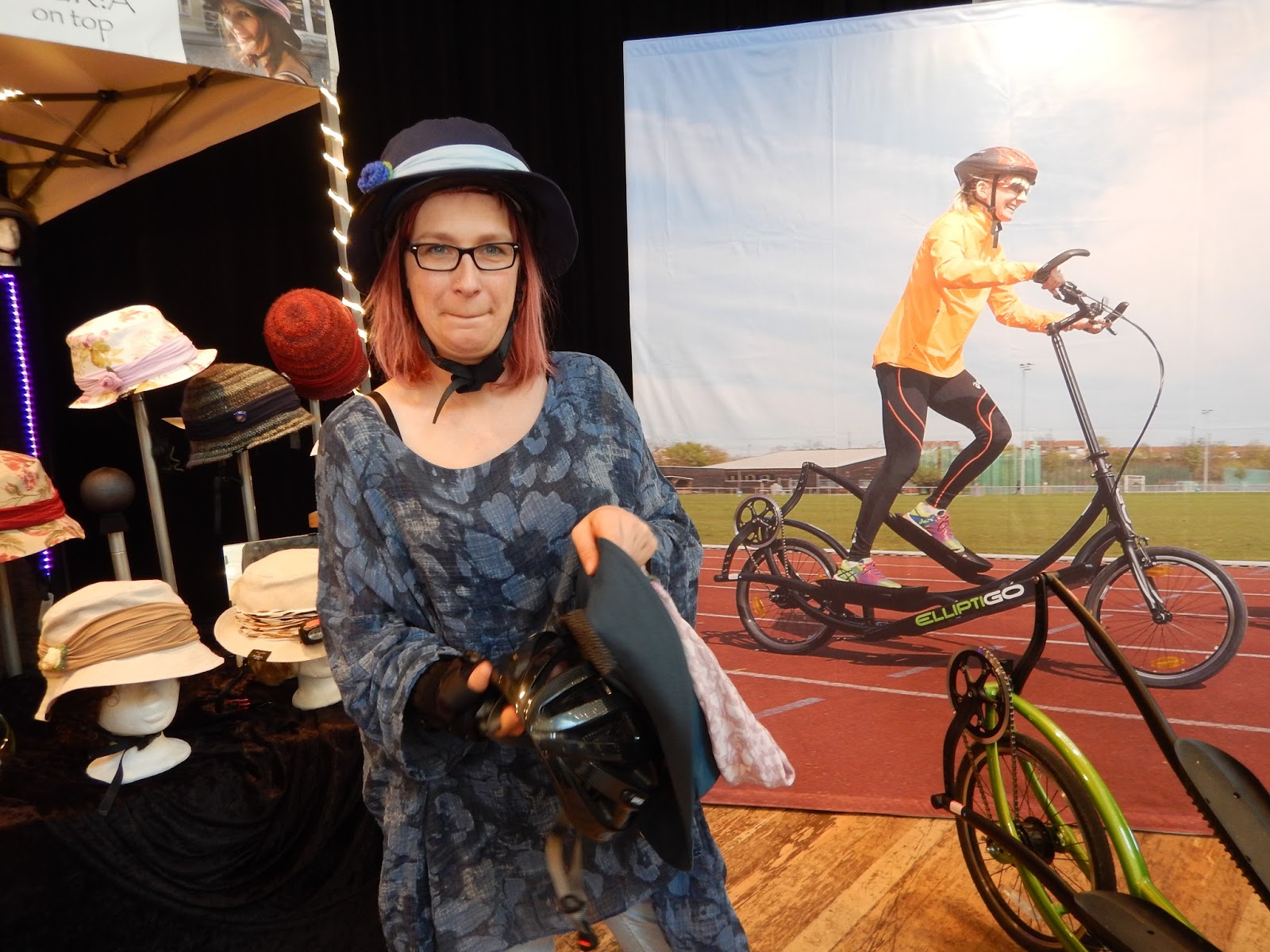
We were interested to find a hat to fit over a cycle helmet on the EVARIA on top stand. They are stylish and manufactured in disabled workshops. You can look cool and help others. A great idea!

We found Monkey Mirrors on the HPV parts stand. These clip on the helmet, are stylish and can be swopped over when one crosses the English Channel. It's an interesting idea, but I already have a mirror and will stick by my present mirror which attaches to the arm of my glasses. A head mirror is a capital wheeze. It could save your life, especially in heavy traffic. They are light. You know what's happening on the road behind you.
In Hall 2 we were pleased to meet Juliane Neuß who runs Junik, a human powered bicycle manufacturer. She is an expert in the ergonomics of cycling, a book and magazine author and runs an interesting bike shop. Years ago she developed a kit to convert a Brompton folding bike to a recumbent. Junik HPV can modify a steel framed Brompton to take a Shimano 8 speed Nexus hub gear, offers proper touring and commuter bicycles for people of small stature and has developed the Sauseschritt and Sausi-Kid, a scooter with a seat for adults and children.

All of the occupants of the various stands (booths) listed above and our fellow Lancastrians on the Advanced Vehicle Design stand that we visited seemed to have a good show and intended to come back next year.
If you can organise it it is worthwhile planning to get to SPEZI a little later, but even if you have to queue at 10:00 a visit to SPEZI is still worthwhile.
This year we could only get to the exhibition by Sunday afternoon at 14:00 (2pm). There were plenty of visitors as we made our way through the street around the halls. This area is blocked off to motorised traffic and so is used as an informal test track and exhibition area by the stands on the external exhibition area. It was a sunny day and the ice cream and dutch frites stand were doing great business judging by the queues.
 |
| A sunny day |
Hall 3 was full of visitors but it is a small hall with some big stands and so there was not much space for the humankind in the aisles. We chatted to the editor of "Fahrradzukunft - Bicycle Future" a German language e-magazine which can also be obtained in print form. We are looking for an author or publisher competent in English to take over some or all of Bergstrasse Bike Books, our cyclist touring guides.
We returned to the informal test track outside and dodged the test pilots some of whom had more enthusiasm than caution to go to Halls 1 and 2 which is where most of the major players in the recumbent trike and e-bike business hang out. These halls had fair number of visitors but did not resemble a rugby scrum. To sum up our impressions fat tyred trikes are definitely in coming, cargo bikes, especially with e-power are now viewed as a serious possibility for deliveries in city centres to reduce air pollution and e-powered bikes and trikes are now mainstream. Carla Cargo build braked trailers with or without electrical power that convert to hand trailers for "last mile" deliveries through a pedestrian zone. AZUB the Czech trike manufacturer, HP and ICE now offer fat tyre trikes.
 |
| A Carla Cargo powered trailer for inner city use. |
 |
| ICE |
 |
| AZUB |
We were interested to find a hat to fit over a cycle helmet on the EVARIA on top stand. They are stylish and manufactured in disabled workshops. You can look cool and help others. A great idea!
We found Monkey Mirrors on the HPV parts stand. These clip on the helmet, are stylish and can be swopped over when one crosses the English Channel. It's an interesting idea, but I already have a mirror and will stick by my present mirror which attaches to the arm of my glasses. A head mirror is a capital wheeze. It could save your life, especially in heavy traffic. They are light. You know what's happening on the road behind you.
In Hall 2 we were pleased to meet Juliane Neuß who runs Junik, a human powered bicycle manufacturer. She is an expert in the ergonomics of cycling, a book and magazine author and runs an interesting bike shop. Years ago she developed a kit to convert a Brompton folding bike to a recumbent. Junik HPV can modify a steel framed Brompton to take a Shimano 8 speed Nexus hub gear, offers proper touring and commuter bicycles for people of small stature and has developed the Sauseschritt and Sausi-Kid, a scooter with a seat for adults and children.

All of the occupants of the various stands (booths) listed above and our fellow Lancastrians on the Advanced Vehicle Design stand that we visited seemed to have a good show and intended to come back next year.
If you can organise it it is worthwhile planning to get to SPEZI a little later, but even if you have to queue at 10:00 a visit to SPEZI is still worthwhile.
Subscribe to:
Posts (Atom)